-
The best PAM tools eliminate standing privilege.
74% of organizations report identity-related breaches, and privileged access is a leading cause of lateral movement.¹
If your Privileged Access Management (PAM) strategy still centers on vaulting passwords, you’re solving yesterday’s problem. AI has changed everything, and organizations must change their approach — and solution for — privileged access if they’re to keep up.
Think about it: it’s not just humans that require privileged access anymore. Cloud workloads, service accounts, and AI agents now need (and in many cases, already have) privileged access.
These identities operate without human interactions. They don’t log off. They don’t use MFA the way humans do. And they often have standing access. Modern enterprises need more than a vault.
Saviynt redefines what the best privileged access management solutions should deliver — not just password protection, but full privileged identity security.
How Is AI Changing the Definition of the Best PAM Solutions?
In short, AI is changing what’s considered the best PAM solution because AI has changed everything. From everyday tasks at home to the fundamental way in which we work as a society, AI has changed the game.
Since the first AI chatbot exploded onto the scene a few years ago, many of us have given these AI agents blanket permissions. We’ve asked for silly stories and tried to break their programming, but we’ve also freely and intentionally given them zettabytes of information about us.
In the cybersecurity sense, we gave them complete access. And as exciting as it is to see what they can do with all of it, the fact of the matter is: every AI agent introduces untold risk to organizations. And they’re multiplying exponentially.
Within the scope of identity security, AI operates on an entirely different level than what we’re used to:
- AI runs continuously. They don’t sleep, eat, take breaks, or even operate at the same speed as humans. They’re inherently faster and more versatile than humans could ever hope to be.
- AI agents often hold broad permissions. Most agents were deployed without guardrails in place. Or, before policies had been enacted or enforced. Even if your organization had guardrails, that only guides implementation for the apps you know about. Shadow deployment and standing privileges are currently the norm for AI, despite the enormous risk.
- They scale rapidly. AI is now ubiquitous, proudly displayed (and sometimes hidden) in every application now brought into your organization. Humans and AI alike can spin up models and agents at the drop of a hat, living, operating, and dying quicker than most access request processes even take to complete.
- They operate without human friction. It’s in the name, after all. AI is artificial intelligence. Humans designed it to learn, grow, and evolve. It’d be silly to imagine they need human bottlenecks or decisions to operate at all. After all, AI agents can create new agents. But AI shouldn’t ever make the important decisions or act without oversight, solidifying the need for systems to enforce human rules at machine speed.
The best PAM tools must now:
● Discover Shadow AI, no matter when or by whom it is deployed.
● Enforce runtime authorization, so policies are enforced and access can be granted in real time.
● Apply zero standing privilege to agents from day, no, second 1.
● Maintain full attribution and accountability throughout agents’ lifecycles.
Why Do Traditional PAM Tools Fall Short?
So why are traditional PAM tools not considered the best PAM solutions in the age of AI? In part, it’s because they were designed for human administrators. The explosion in the number and types of identities (including those that grant permissions and access themselves) creates a much more varied landscape.
DevOps, SecOps, and even business users all need privileged access throughout organizations. Organizations are even beginning to grant privileged access to AI agents and non-human identities — something that will only continue as AI capabilities increase.
Organizations must approach PAM holistically, going beyond vaults and even human-led processes. You must be able to govern the identities themselves, no matter who or what they are, and marry your PAM efforts with IGA if you’re to scale securely.
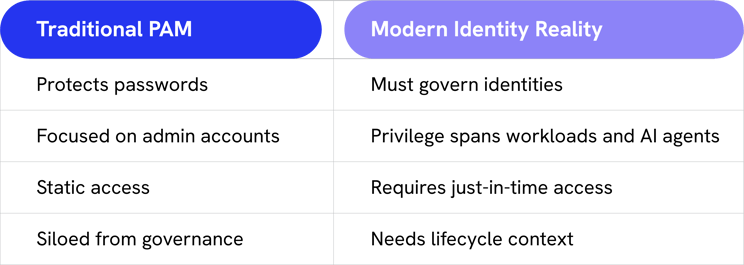
Traditional PAM tools protect credentials. They understand that a password or credential exists in a place and secures it. But the system doesn’t understand anything beyond that.
The best PAM solutions protect privileged identities. Knowing who or what that password belongs to, with the context of its place within the larger organization, is what sets the best privileged access management tools apart — and will keep your enterprise secure. Here’s the difference between legacy tools and modern identity solutions:
What Is the Best PAM Solution?
Today, the best PAM solution is one that understands the evolving needs of the AI-first enterprise. It solves the same challenges that enterprises have struggled with for years and addresses the mounting questions (and issues) posed by new technology. When considering your options, there are several key features and capabilities to look for.
What Features Should I Look for in a PAM Tool?
Eliminates standing privilege
Standing privileges have long been a thorn in many organizations’ sides. AI’s capabilities and very nature exacerbate enterprises’ need for strong, least privilege practices. To eliminate standing privilege, you must have a PAM solution that understands identities (both human and AI), their lifecycles, and access, and revokes access as soon as it becomes unnecessary.
Supports Just-in-Time access
Eliminating given access once it’s no longer needed is the goal, of course. But what’s even better is preventing errant access in the first place. Just-in-Time access allows admins to specify the right level of access for the right user for the right amount of time for the right task. And, it automatically terminates at the end of the specific period and always falls within your designed approval workflows.
Secures hybrid and multi-cloud
The modern enterprise isn’t built on a single environment. The best privileged access management solutions must function within every type of environment: on-premises, public or private cloud, hybrid, and multi-cloud. As more workloads have moved to the cloud, traditional PAM (which was designed for on-prem environments) can’t properly protect cloud resources. Cloud-native PAM, however, natively supports any cloud architecture and easily extends to on-premises environments.
Extends to AI agents
Every workflow in your identity security program must extend to every type of identity in it: human, non-human, and AI. Non-human identities outnumber humans 82:12, but they’re often governed less than human identities. Any organization that doesn’t address the changing requirements and innovations from AI use throughout its identity security program — including PAM — is one that’s likely to be left behind by its competition. AI agents must be discovered, governed, and authorized at runtime — especially given AI’s lack of MFA use — if your organization is to securely scale its AI-enabled operations.
Integrates natively with identity governance
Decisions should never be made in a vacuum, and holistic identity security can only occur when multiple workstreams come together. Integrating PAM and IGA together means each function has knowledge from the other, allowing your organization to enforce consistent policies, make smarter decisions with shared risk context, provide a consistent user experience, and grant full lifecycle visibility and control.
What Is Next-Generation PAM?
Legacy, vault-first tools cannot meet the requirements of modern enterprises. However, identity-centric platforms can. They elevate from traditional PAM and build from the foundation of IGA to deliver end-to-end lifecycle management, complete audit readiness, continuous compliance, and enhanced operational efficiency all within a single, end-to-end, connected experience. This allows organizations to scale their entire identity security program — including PAM and other key components.
How Does Saviynt Compare to Other PAM Tools?
The Saviynt Identity Platform is your single control plane for securing and governing all entities in your organization: all identities, all apps, and every environment. It allows you to create a holistic identity security program that goes beyond what traditional (and even modern point) PAM solutions offer. By converging IGA, PAM, application access governance (AAG), identity security posture management (ISPM), and AI security, the Saviynt Identity Platform allows you to secure your entire enterprise.
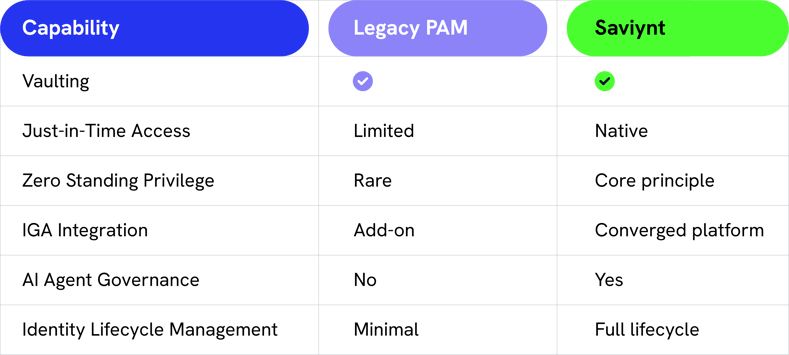
Saviynt delivers one of the best privileged access management solutions because it treats privilege as an identity problem. By taking an identity-centric approach and adopting an identity-first mindset, your organization can strengthen your PAM practice today and be prepared for whatever is next on the horizon.
To learn more about Saviynt PAM, please visit our website.