
- The EU AI Act follows a risk-based approach, with requirements that vary by the AI system's intended purpose, classification, and the organization's role.
- Certain AI practices are prohibited, while high-risk AI systems face extensive requirements involving risk management, data governance, documentation, human oversight, and cybersecurity.
- Some AI systems have specific transparency obligations even when they are not classified as high-risk.
- General-purpose AI models are subject to a separate set of provider obligations, with additional requirements for models presenting systemic risk.
- Minimal regulatory risk does not mean zero security risk. Organizations still need to secure and govern their AI systems and models, even when few or no mandatory AI Act requirements apply.

Not sure if the EU AI Act applies to your organization? Check out Part 1 of the series to find out.
Once leaders understand if the EU AI Act applies to their organizations, it’s only the first step toward compliance. Whether headquartered in the EU, the United States, or elsewhere, organizations operating within the Act's scope must understand their obligations based on how they develop, provide, or use AI, and determine which requirements apply to their AI systems and models.
Those obligations vary depending on an AI system's intended purpose, risk classification, and the organization's role. A company developing a high-risk AI system for the European market may face different requirements than one deploying a third-party AI tool, even when both operate in the same market.
For companies under the purview of the EU AI Act, it’s important to examine the Act’s major risk categories and compliance requirements for organizations worldwide, including prohibited practices, high-risk AI systems, transparency obligations, and general-purpose AI models.
What are the EU AI Act risk categories?
The EU AI Act takes a risk-based approach, distinguishing between prohibited AI practices, high-risk systems subject to extensive compliance requirements, and systems with more limited obligations. An AI system's intended purpose and use help determine its regulatory treatment (i.e., what organizations must do based on how much risk their AI systems and models present).
The Act is commonly explained through four risk groupings:
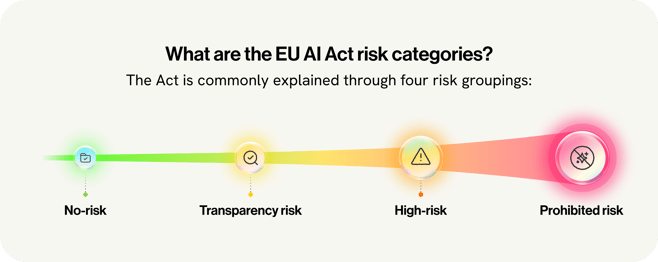
The table above intentionally keeps those responsibilities high-level. The next article in this series will examine the EU AI Act's risk categories and compliance requirements in detail.
|
Risk category |
What it means |
Example |
Regulatory treatment |
|
Unacceptable/prohibited risk |
AI practices considered incompatible with fundamental rights or other protected interests. |
Certain forms of social scoring or prohibited biometric categorization. |
Prohibited under the Act, subject to the specific conditions and exceptions in its provisions. |
|
High-risk |
AI systems that meet specified criteria involving regulated products or particular use cases. |
AI used to evaluate job applicants or determine eligibility for certain essential services. |
Extensive requirements covering risk management, data governance, documentation, oversight, and other safeguards. |
|
Transparency risk |
AI systems or uses that trigger specific disclosure or transparency obligations. |
Certain chatbots, deepfakes, or AI-generated content. |
Requirements to inform users or disclose or mark AI-generated or manipulated content, as applicable. |
|
Minimal/no-risk |
AI systems that do not fall within the Act's prohibited, high-risk, or specific transparency provisions. |
AI-powered spam filters or certain routine recommendation tools. |
Generally few or no mandatory requirements under the AI Act, although other laws may still apply. |
These groupings are not a simple scale where each category adds another layer of requirements. Prohibited practices cannot be made permissible through additional controls, while high-risk systems must meet extensive requirements before being placed on the market or put into service. Transparency obligations may also apply independently of a system's high-risk classification.
Importantly, minimal regulatory risk does not mean zero security risk. Even AI systems facing few or no mandatory requirements under the Act can introduce security vulnerabilities, access risks, and governance challenges. Organizations still need appropriate controls regardless of regulatory classification.
General-purpose AI (GPAI) models have separate regulatory requirements outside these commonly used AI-system risk groupings, which we'll examine later in this article.
What AI practices are prohibited under the EU AI Act?
Some AI practices pose unacceptable risks to fundamental rights, safety, or human autonomy. Rather than impose stricter compliance requirements, the EU AI Act prohibits these practices, subject to limited exceptions.
Under Article 5 of the EU AI Act, which went into effect on February 2, 2025, prohibited practices include:
- Manipulative or exploitative AI: Systems that use deceptive or manipulative techniques, or exploit vulnerabilities related to age, disability, or socioeconomic circumstances, to materially distort behavior and cause or risk significant harm.
- Social scoring: AI systems that evaluate people based on social behavior or personal characteristics and impose unjustified, disproportionate, or unrelated unfavorable treatment.
- Certain biometric and emotion-recognition practices: AI used to infer emotions in workplaces or educational institutions, except for medical or safety purposes, and biometric categorization systems that infer certain sensitive personal characteristics.
- Certain predictive policing practices: AI systems that predict an individual's likelihood of committing a criminal offense based solely on profiling or personality traits.
- Untargeted facial-image collection: AI systems that build or expand facial recognition databases by indiscriminately scraping facial images from the internet or CCTV footage.
The Act also restricts real-time remote biometric identification in publicly accessible spaces for law enforcement, with limited exceptions and strict safeguards.
Additional prohibitions introduced through the AI Omnibus, a 2026 amendment to the EU AI Act, apply from December 2, 2026. These address AI systems that generate or manipulate non-consensual intimate content or child sexual abuse material, subject to the specific conditions established by the Act.
Unlike high-risk AI, which may be developed and used when applicable requirements are met, prohibited practices cannot be made compliant simply by adding oversight, documentation, or security controls.
What qualifies as high-risk AI under the EU AI Act?
High-risk AI systems meet specific criteria related to their intended purpose and potential impact on health, safety, or fundamental rights. These systems may be developed and used when they meet applicable regulatory requirements.
Article 6 of the Act establishes two primary ways an AI system can be classified as high-risk:
- AI used in certain regulated products. AI that is itself a product, or serves as a safety component of one, covered by specified EU product-safety legislation and requiring third-party conformity assessment. This can include AI embedded in physical equipment as well as qualifying standalone software, such as certain AI-enabled medical devices.
- AI used for specified purposes under Annex III. Systems used in contexts that affect individuals' rights, opportunities, or safety, including employment decisions, educational assessments, safety-critical infrastructure, creditworthiness evaluations, and certain biometric identification activities.
The second category is especially relevant to everyday business operations. For example, AI used to screen job applicants or determine eligibility for essential public benefits may qualify as high-risk because it influences consequential decisions.
However, using AI in a regulated industry or sensitive business function does not automatically make every system high-risk. Classification depends on the specific intended purpose and applicable criteria.
Article 6 provides limited exceptions for certain Annex III systems that do not pose a significant risk of harm, including systems that perform narrow procedural or preparatory tasks and do not materially influence decision-making. These exceptions are subject to specific conditions, and Annex III systems that profile individuals are always considered high-risk.
Organizations must therefore evaluate AI systems individually rather than classify them solely by industry or department.
What are the requirements for high-risk AI systems?
High-risk AI systems are subject to extensive requirements under Articles 9 through 15 of the EU AI Act, covering their development, testing, documentation, monitoring, and oversight. These requirements follow phased application dates, which we'll examine in Part 3.
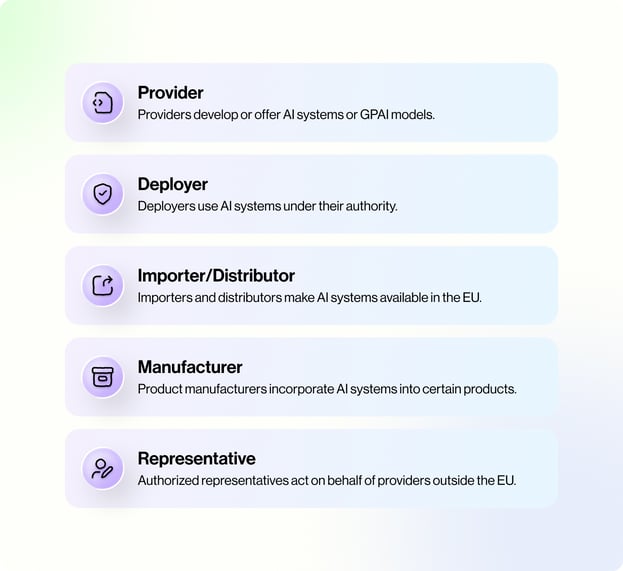
Responsibilities vary by organizational role (see the graphic below). Providers are primarily responsible for meeting the Act's system-development and conformity requirements, while deployers have separate obligations governing how they use and oversee systems.
Risk management and governance
Providers of high-risk AI systems must establish, document, and maintain a risk management system throughout the system's lifecycle. Under Article 9, this includes identifying and evaluating risks to health, safety, and fundamental rights arising from intended use and reasonably foreseeable misuse, implementing mitigation measures, and testing systems to verify their performance. Findings from post-market monitoring must also inform ongoing risk assessments.
Effective risk management also requires clear organizational accountability. Product development, compliance, security, and other relevant teams need defined responsibilities for identifying risks, evaluating controls, documenting decisions, and responding to emerging issues.
Deployers also have responsibilities, including monitoring high-risk systems according to their instructions for use and taking appropriate action when risks or serious incidents are identified.
Data and data governance
Article 10 establishes data governance requirements for training, validation, and testing datasets used in high-risk AI systems. Where applicable, these datasets must be relevant, sufficiently representative, and, to the greatest extent possible, free of errors and complete for their intended purpose.
Providers must implement appropriate data management practices, including examining data sources, identifying gaps, and assessing potential biases that could affect health, safety, fundamental rights, or lead to unlawful discrimination.
For example, an AI hiring system trained on data that disproportionately represents certain groups may disadvantage qualified applicants from underrepresented populations. Appropriate data governance helps organizations identify and mitigate these risks before they affect real-world decisions.
Specific requirements depend on how the system is developed and which datasets are used. Deployers must also ensure that input data under their control is relevant and sufficiently representative for the system's intended purpose.
Documentation, logging, and traceability
Article 11 requires providers of high-risk AI systems to maintain technical documentation demonstrating compliance. This includes information about the system's intended purpose, design, development, capabilities, limitations, and relevant risk management and testing activities.
Under Article 12, high-risk AI systems must also support automatic event logging to establish traceability, identify potential risks, and support ongoing monitoring. Deployers must retain automatically generated logs under their control for at least six months, unless other applicable laws require a different period.
Documentation and logging help organizations demonstrate compliance, investigate incidents, and respond to regulatory inquiries. They also make it easier to trace how an AI system operates and identify whether its controls are working as intended.
Transparency and human oversight
Under Article 13, providers of high-risk AI systems must supply clear instructions and information about their intended purpose, performance, limitations, potential risks, and required oversight measures. This helps deployers use these systems appropriately.
Article 14 requires high-risk AI systems to be designed so people can effectively oversee their operation, recognize limitations, interpret outputs, and intervene when necessary. Deployers must assign oversight responsibilities to individuals with the appropriate competence, training, authority, and support.
For example, personnel overseeing an AI hiring system should recognize questionable recommendations, understand the system's limitations, and avoid automatically relying on its conclusions. Human oversight must be meaningful, not a procedural formality.
Certain high-risk uses also require organizations to inform affected individuals that AI is being used in decisions concerning them.
Accuracy, robustness, and cybersecurity
Article 15 requires high-risk AI systems to maintain appropriate levels of accuracy, robustness, and cybersecurity throughout their lifecycle.
Accuracy concerns whether a system performs reliably for its intended purpose, while robustness addresses its ability to withstand errors, faults, or unexpected conditions without producing unsafe outcomes.
Cybersecurity requirements focus on protecting AI systems against threats that could compromise their integrity, availability, or operation. These include AI-specific attacks involving manipulated inputs, poisoned training data, and unauthorized interference with system behavior.
For organizations, these requirements reinforce the need to evaluate AI security alongside traditional application and infrastructure security. Access controls, monitoring, and safeguards against unauthorized changes help protect the systems, data, and models involved.
What are the EU AI Act's transparency requirements?
Under Article 50 of the EU AI Act, certain systems face transparency obligations even when they are not classified as high-risk. These requirements, which began applying on August 2, 2026, help people recognize when they are interacting with AI or encountering AI-generated content. Specific obligations depend on whether an organization provides or deploys the system.
Key transparency obligations include:
- Disclosing AI interactions: Providers must ensure that systems designed to interact directly with people, such as certain chatbots, inform users they are interacting with AI unless that fact is already obvious.
- Marking AI-generated content: Providers of systems generating synthetic text, images, audio, or video must ensure applicable outputs are marked in a machine-readable format identifying them as AI-generated or manipulated.
- Disclosing deepfakes and certain public-interest content: Deployers must disclose applicable AI-generated or manipulated deepfakes and text published to inform the public on matters of public interest, unless the text has undergone human review or editorial control and someone holds editorial responsibility for its publication.
- Informing individuals about certain biometric uses: Deployers of applicable emotion-recognition or biometric-categorization systems must inform affected individuals, subject to specified exceptions.
The Act includes exceptions for certain uses, including some law enforcement activities, standard editing functions, and creative works. Required disclosures must be clear and accessible.
These requirements mean organizations must account for what users are told about AI, not just how the systems perform.
What are the requirements for general-purpose AI?
General-purpose AI (GPAI) models can perform a wide range of tasks and serve as the foundation for different AI systems. Unlike AI systems classified by intended use, GPAI models face separate requirements under the EU AI Act.
Article 53 establishes obligations for providers of GPAI models, including:
- Technical documentation: Maintaining information about model development, training, testing, and evaluation to demonstrate compliance.
- Information for downstream providers: Providing documentation to help organizations integrating the model understand its capabilities, limitations, and compliance requirements.
- Copyright compliance: Establishing policies to comply with EU copyright law, including applicable rights reservations concerning training data.
- Training-content transparency: Publishing a sufficiently detailed summary of training content using the EU AI Office's template.
Certain qualifying open-source models are exempt from some documentation obligations, although copyright and training-content transparency requirements still apply.
Providers of GPAI models classified as presenting systemic risk face additional requirements. Unlike high-risk AI systems, which are classified based on specific uses or regulated-product criteria, systemic-risk GPAI models are assessed based on their capabilities and potential wider effects across applications or society.
Under Article 55, providers must conduct model evaluations and adversarial testing, assess and mitigate systemic risks, report serious incidents, and maintain appropriate cybersecurity protections.
Using a GPAI model does not automatically make an organization its provider. However, organizations that develop or significantly modify GPAI models may assume provider responsibilities, while those building AI systems on existing models must assess their own obligations.
What does EU AI Act compliance look like in practice?
There is no universal EU AI Act compliance checklist. Requirements depend on the AI systems and models involved, their intended use and classification, and the organization's role.
Five steps can help establish that foundation:
- Determine applicability and organizational roles. Establish whether the Act applies and whether your organization acts as a provider, deployer, or another regulated operator for each relevant system or model.
- Inventory relevant AI systems and models. Identify AI developed, provided, or used across the organization, including applicable third-party technologies.
- Classify AI systems and models. Evaluate intended uses to identify prohibited practices, high-risk systems, transparency obligations, and GPAI models with separate provider requirements.
- Map applicable requirements. Connect each system or model to the obligations associated with its classification and your organization's role.
- Identify compliance gaps. Compare existing governance, documentation, oversight, and security controls against applicable requirements to determine what needs improvement.
For example, a company using AI to screen job applicants might identify the system as high-risk, establish its responsibilities as a deployer, and assess whether its existing human oversight, monitoring, and recordkeeping practices meet the applicable requirements.
Organizations should assess each AI system individually, as different systems may carry different requirements depending on their intended purpose, risk classification, and the organization’s role in providing or deploying them.
These five steps, however, establish a framework for what an organization must address. The next question is when those requirements apply and what needs attention first.
Part 3 of this series examines the EU AI Act's phased compliance timeline, upcoming deadlines, and practical preparation priorities.