AI adoption means more identities generating access requests to enterprise applications and critical information. This also puts more pressure on security teams to bring applications under governance quickly, rather than leaving access unmanaged across the organization.
Every identity security program has the same bottleneck: the time it takes to get an application under governance. Before you can enforce least privilege or run an access certification, someone has to build the connector — mapping a target application’s API, handling its quirks, and translating its access model into something the platform understands. In many instances, that's the identity security platform vendor for core, widely used applications. In others, development happens in-house or is contracted out. Either way, each connector's development is often measured in weeks or months.
That bottleneck compounds fast, and it's compounding faster now that AI is being adopted, knowingly and unknowingly, in all corners of a business. A security program with dozens, or hundreds, of applications to onboard has a security gap for each one. Unreviewed access and untracked entitlements pile up because the application hasn't made it through the queue. This same bottleneck keeps organizations locked into IGA platforms they've outgrown: migrating means rebuilding years of configuration from scratch.
In June, we announced our integration with the Claude Compliance API, bringing access to Claude Enterprise under identity governance with automated onboarding and offboarding, least-privilege enforcement, continuous access certification, and more for the people (and increasingly, the agents) working with Claude. That was about delivering governance to Claude. This is about something different: using Claude to accelerate identity security throughout the organization.
Quickly onboard any application to your identity security program.
Where onboarding time actually goes
Two things eat most of the onboarding timeline. First, every application's REST API is shaped differently — inconsistent field names, undocumented endpoints, payloads that must be manually parsed before anyone can start building a connector. Second, for organizations migrating off a legacy IGA tool, there's a translation problem: years of accumulated configuration that someone has had to reinterpret.
Neither of these requires new architecture to solve. They take careful, repetitive, time-consuming, and costly effort that large language models such as Claude are well suited to accelerate.
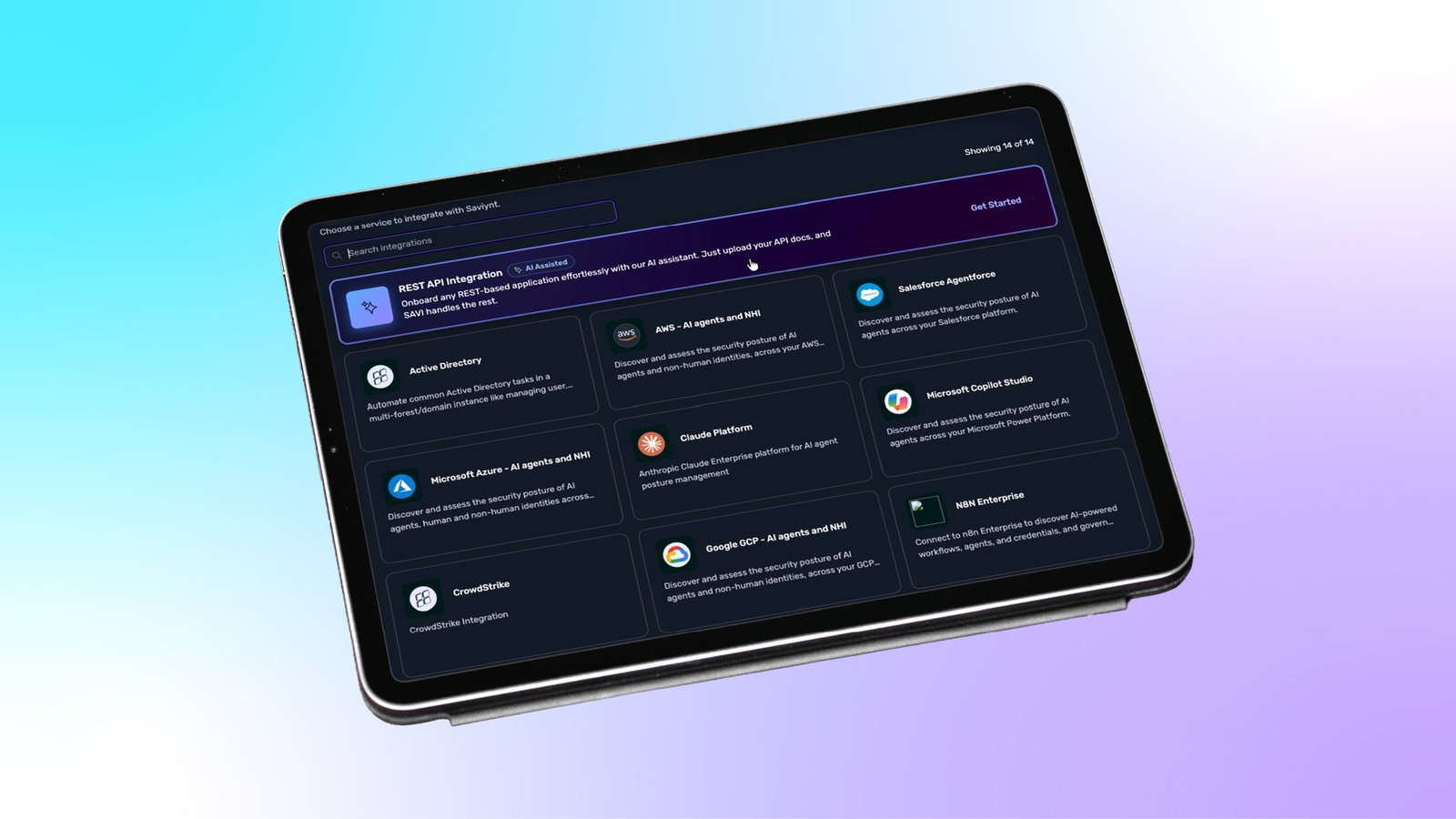
Saviynt helps power accelerated application onboarding using Claude through the following features:
- An Automated REST Onboarding Engine that autonomously reads a target application's API specifications, filters out non-essential metadata, and normalizes messy or inconsistent data formats while automatically mapping dependencies across endpoints so integrations run in the right order without manual sequencing, for seamless, error-free workflows.
- A Legacy Migration Agent that takes existing configurations from legacy systems like SailPoint or Oracle Identity Manager and automatically converts them into Saviynt, reducing work that used to take weeks or months to minutes.
- For legacy and non-API applications, the Integration Agent connects directly through their user interface — interpreting natural-language instructions to locate on-screen elements, navigate workflows, and complete tasks end to end, without needing a native API or standard integration framework.
- Saviynt’s SaviAI Copilot gives administrators a natural-language way to work with the platform directly — describing what they need in plain text and having it translated into authenticated API actions, with schema documentation retrieved instantly rather than looked up by hand.
- Ahead of a platform upgrade or migration, the Pre-Upgrade Risk Scorecard uses Claude to read and reason over an organization's custom rule configurations. Instead of a manual line-by-line review, the scorecard surfaces which rules are likely to break, which are safe, and which need a human look — cutting review time from upwards of three hours to about thirty minutes.
Together, these lower the cost of bringing a new application under governance — not by cutting corners, but by removing the manual translation work that used to stand between "we want to govern this application" and actually doing it.
Claude provides the foundation that Saviynt uses to accelerate application onboarding.
Accelerating application onboarding reduces an organization's threat landscape by providing:
- Faster security program time-to-value. Value from a security program, including that delivered through certifications, access reviews, SoD checks, etc., doesn't start until an app is onboarded. A slow onboarding queue delays the program's ability to reduce one’s risk landscape effectively.
- Lower total cost of ownership. Connector-building has historically required in-house engineering time or paid professional services. Automating the schema-parsing and normalization work is a direct cost reduction — fewer billable hours, and less engineering time diverted from higher priorities.
- Coverage of long-tail and custom apps. Most vendors have solid out-of-the-box connectors for common systems. Homegrown, niche, or poorly documented internal applications are where onboarding drags and where governance and security gaps quietly live the longest.
- A reduction in tedious, repetitive administrative work. SaviAI Copilot's natural-language layer means extending coverage doesn't require a dedicated integration specialist on staff, which matters for teams that would otherwise deprioritize onboarding new apps indefinitely because they lack highly technical resources.
- A real answer to prohibitive switching costs. The biggest reason organizations stay on an identity platform they've outgrown is that leaving means redoing years of configuration by hand or spending a lot of money to have someone do it for them. Accelerating that migration removes the thing locking you into a solution you may not be thrilled to keep, turning "start completely over" into "import what you already built."
Our work with Anthropic and Claude is part of a broader pattern: using LLMs and AI to secure access to critical information. If your applications, agents, and non-human identities are growing faster than your governance program can onboard them, that gap is where risk lives — not in the systems you've already secured. Whether you're standing up identity security for the first time or migrating off a platform that can no longer keep pace, see what accelerated application onboarding looks like with Saviynt and Claude.