At Identiverse, Saviynt introduced Intent-Aware Runtime Authorization (IARA) within Agent Access Gateway, an advanced approach to securing AI agents at runtime. The response from customers was immediate. Yet one question surfaced repeatedly: "Don't we already have an AI gateway?" The answer is often yes, but it's also incomplete.
The challenge is that "AI gateway" has become an umbrella term for very different security capabilities. Prompt filtering, model governance, MCP connectivity controls, and runtime authorization all solve different problems. Treating them as interchangeable creates dangerous blind spots that only become visible when AI agents begin interacting with business-critical systems and sensitive data.
As organizations move from AI experimentation to AI-powered operations, they must answer three fundamental questions:
- What information is flowing between humans and AI models?
- Which tools, models, APIs, and MCP servers can AI agents access?
- What should an AI agent actually be allowed to do once it connects?
Each question requires a different layer of control.
Content Security Gateway
Content security gateways focus on prompts and model outputs. They help detect prompt injection attacks, prevent sensitive data leakage, enforce content policies, and reduce unsafe responses. This is where most organizations begin their AI security journey.
MCP and LLM Routing Gateway
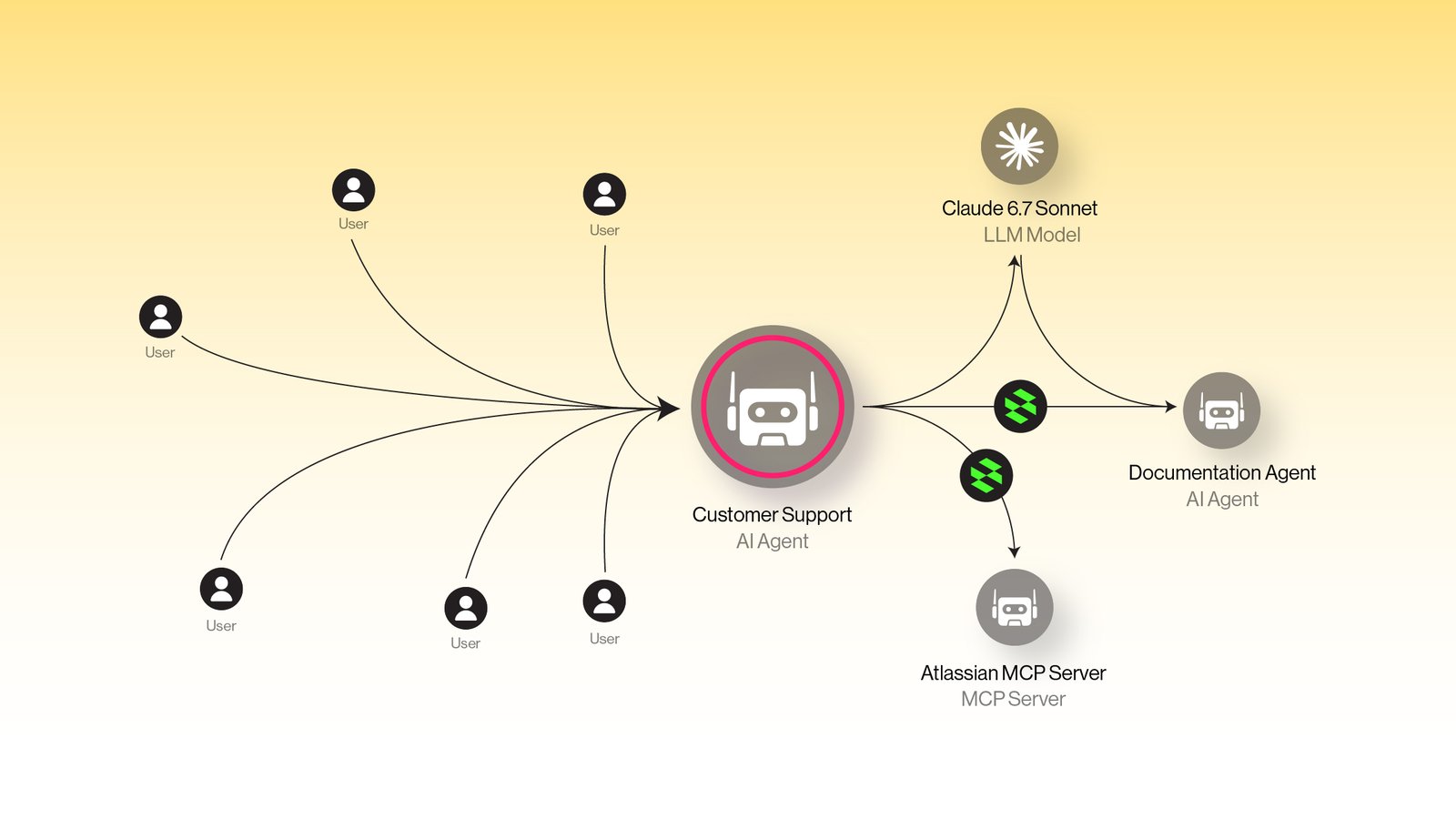
Connectivity gateways govern which tools, MCP servers, APIs, and external services AI agents can access. These controls determine whether an agent can reach enterprise systems or proprietary applications.
Agent Access Gateway
The third layer addresses a question that neither content security nor connectivity governance can answer: What is the agent authorized to do after it connects? This is where the largest security gap exists today and exactly what Agent Access Gateway is designed to solve.
The gap standard controls don't close
AI agents make calls to downstream applications on behalf of users — reading records, writing data, calling external APIs — programmatically, without rate constraints, and potentially across many applications in a single session. When an agent holds a service account credential or a broadly scoped token, its permission surface is not bounded by the user's own entitlements. Standard models — RBAC, coarse-grained OAuth scopes, network perimeter rules — determine whether a session can access an application. They do not control which operations within that application a specific agent is permitted to invoke in a specific context.
Agent Access Gateway closes that gap by combining identity context, task intent, runtime signals, and governance policies to ensure agents are authorized not only to access systems, but to perform the specific actions the task actually requires.
Agent Access Gateway with Intent-Aware Runtime Authorization
As part of Saviynt Identity Security for AI, Agent Access Gateway evaluates whether the requested action aligns with the agent's intended purpose. This distinction is critical.
Consider an HR assistant agent tasked with helping an employee update their benefits enrollment. The agent may legitimately have access to Workday and permission to invoke HR-related tools. The employee may have valid authorization. Yet if the agent suddenly attempts to retrieve executive compensation records or modify payroll data, something is clearly wrong. Other gateway controls would allow the request because the agent technically has access.
Intent-Aware Runtime Authorization in Agent Access Gateway evaluates the request in context:
- What task was the agent assigned?
- Which user is being represented?
- Which resources are relevant to that task?
- Which actions should reasonably occur during execution?
- Does the requested action align with expected behavior?
The action can only proceed once those conditions are satisfied. This moves authorization beyond static permissions and into dynamic, contextual decision-making.
This decision-making is displayed in the four implementation phases that make up Agent Access Gateway.
Agent Access Gateway: Four implementation phases
Agent Access Gateway sits between agent clients and the MCP servers that front your applications. It receives tool call requests, evaluates them against policy, and either forwards or rejects them before they reach the application. The following four phases describe an incremental implementation path — each addressing a distinct gap left open by the previous phase.
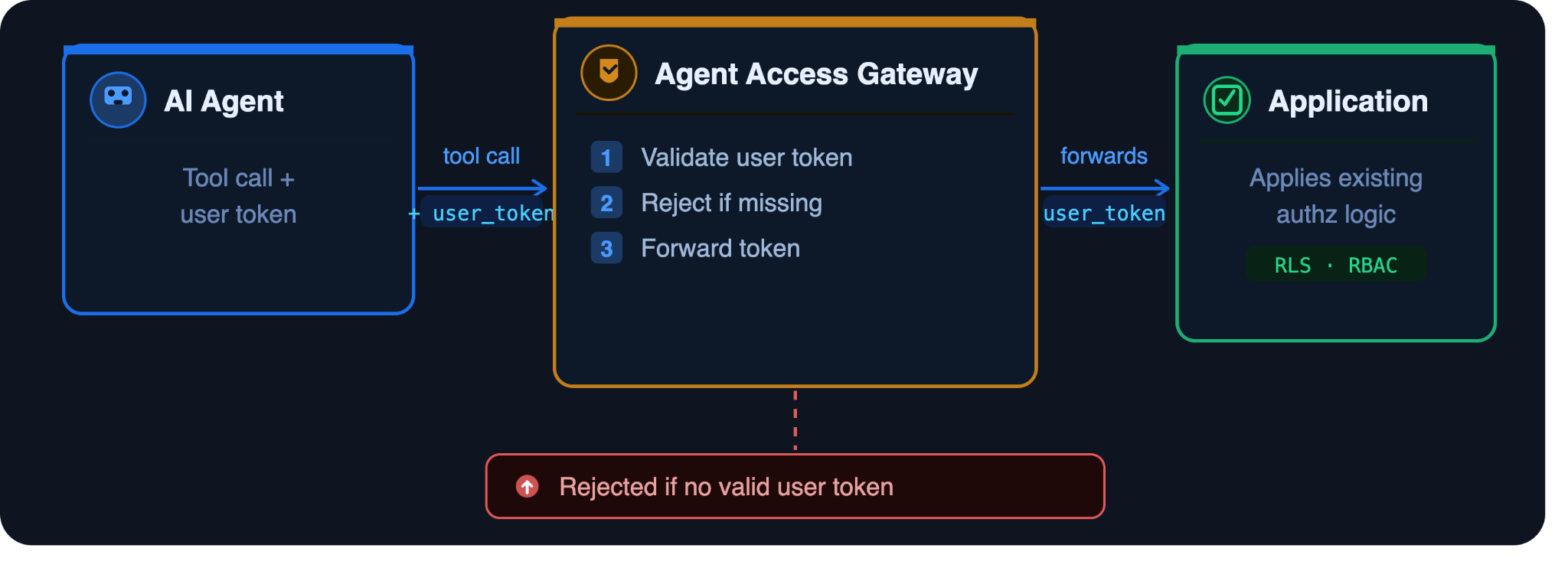
Phase 1 — Credential Pass-Through: Bind the agent to the user's permission surface
The most straightforward control requires that every tool call the agent makes to a downstream application carries the authenticated user's token, not a service account or agent identity. The Agent Access Gateway validates that an unexpired user bearer token is present on each inbound request, then forwards that token to the application.
Because the application receives the user's own credential, its existing authorization logic applies directly. Row-level security, resource ownership checks, and role assignments already scoped to that user govern what data the agent can retrieve or modify. The agent cannot access any resource the user could not access in a direct session. This phase requires no changes to the application authorization logic. The gateway's only enforcement action is to reject requests that lack a valid user token.
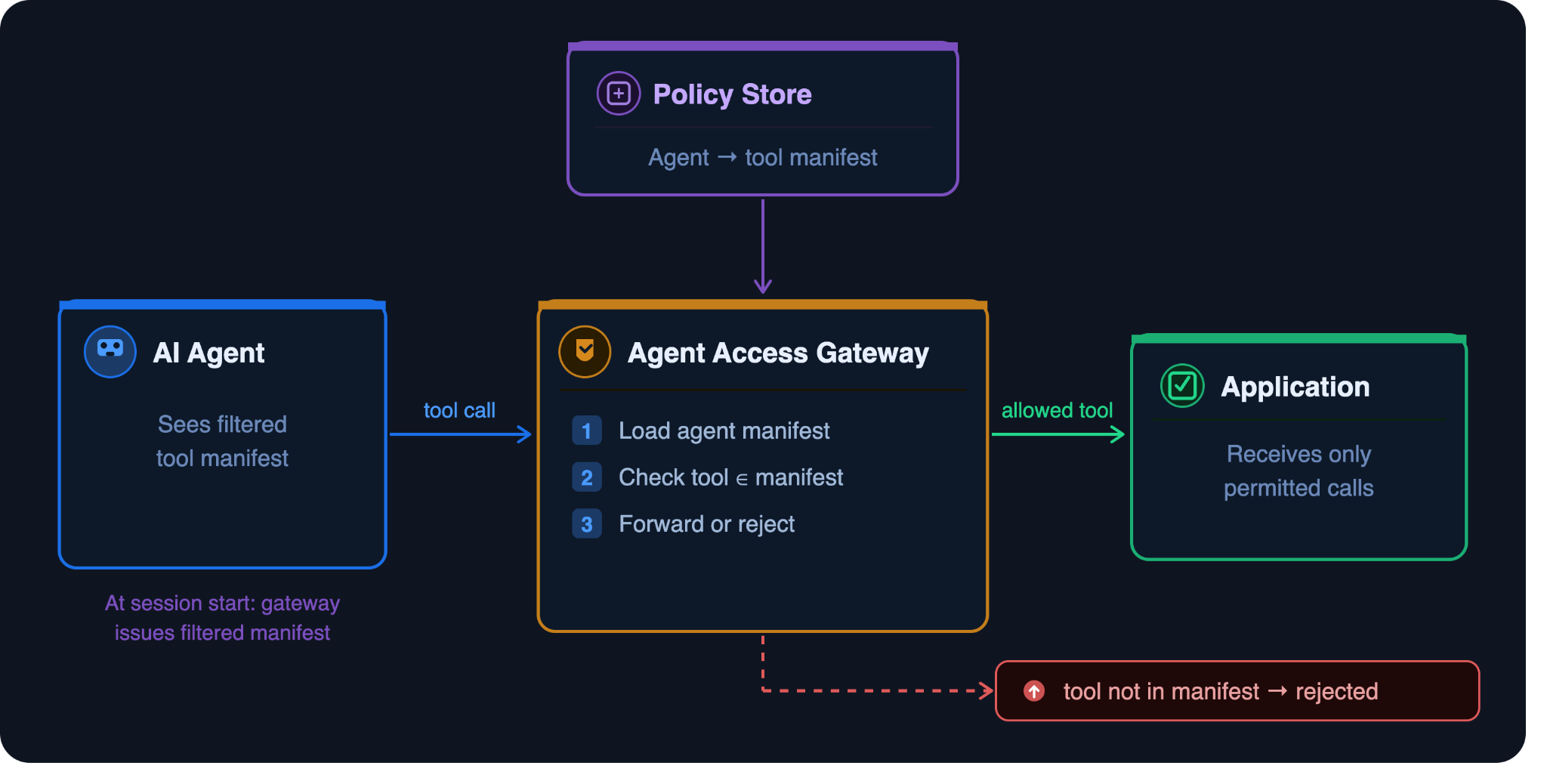
Phase 2 — Tool Filtering: Restrict the agent's callable action set
A user token constrains who is acting. It does not constrain which tools the agent can call on that user's behalf. An MCP server may expose tools for creating, reading, updating, deleting, exporting, and bulk-modifying records. A user with write permissions to an object type can, under credential pass-through alone, have an agent call any of those tools.
At this phase, Agent Access Gateway maintains a policy layer that maps agent type, session context, or declared intent to a permitted set of tools. When an agent session is established, the gateway issues a filtered tool manifest. Tool calls that reference tools outside the manifest are rejected at the gateway before reaching the application. As a secondary benefit, tool filtering also reduces the impact of prompt injection attacks — a manipulated agent cannot invoke tools it was never issued.
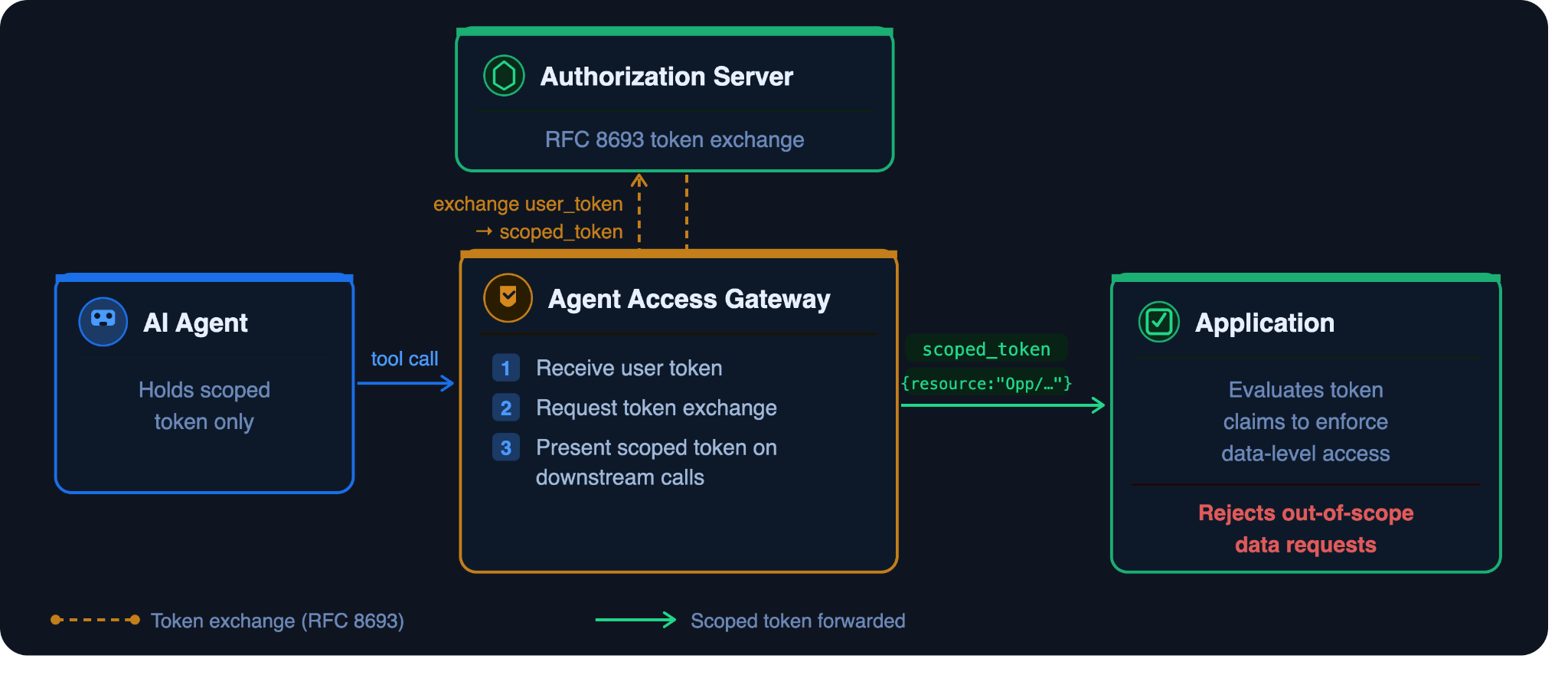
Phase 3 — Token Exchange and Data Scoping: Limit access to task-relevant data
A user's token, issued by an authorization server, typically grants access to all resources the user is entitled to view. For an agent working on a specific task, the full scope of the user's token is broader than what the task requires.
OAuth 2.0 Token Exchange (RFC 8693) provides the mechanism to address this. When an agent session is established, Agent Access Gateway exchanges the user's token at the authorization server for a narrower token. The narrower token carries claims that encode the specific resources the agent may access for this task: a specific record ID, a document identifier, a date-bounded query range, or a set of permitted data classifications. The downstream application enforces access based on the claims in the scoped token; any request for a resource outside the token's claims is rejected by the application. This phase requires integration between Agent Access Gateway and the authorization server, and requires the application to evaluate token claims as part of its authorization decisions.
Phase 4 — Agent Lifecycle Attributes: Include agent identity in access decisions
The first three phases make access decisions based on user identity, session context, and task scope. They do not account for the agent's own attributes. Agent lifecycle management systems track metadata about agents: the model version the agent runs, whether the agent has been reviewed and approved for production use, which data classifications the agent is certified to access, and whether recent sessions produced anomalous outputs.
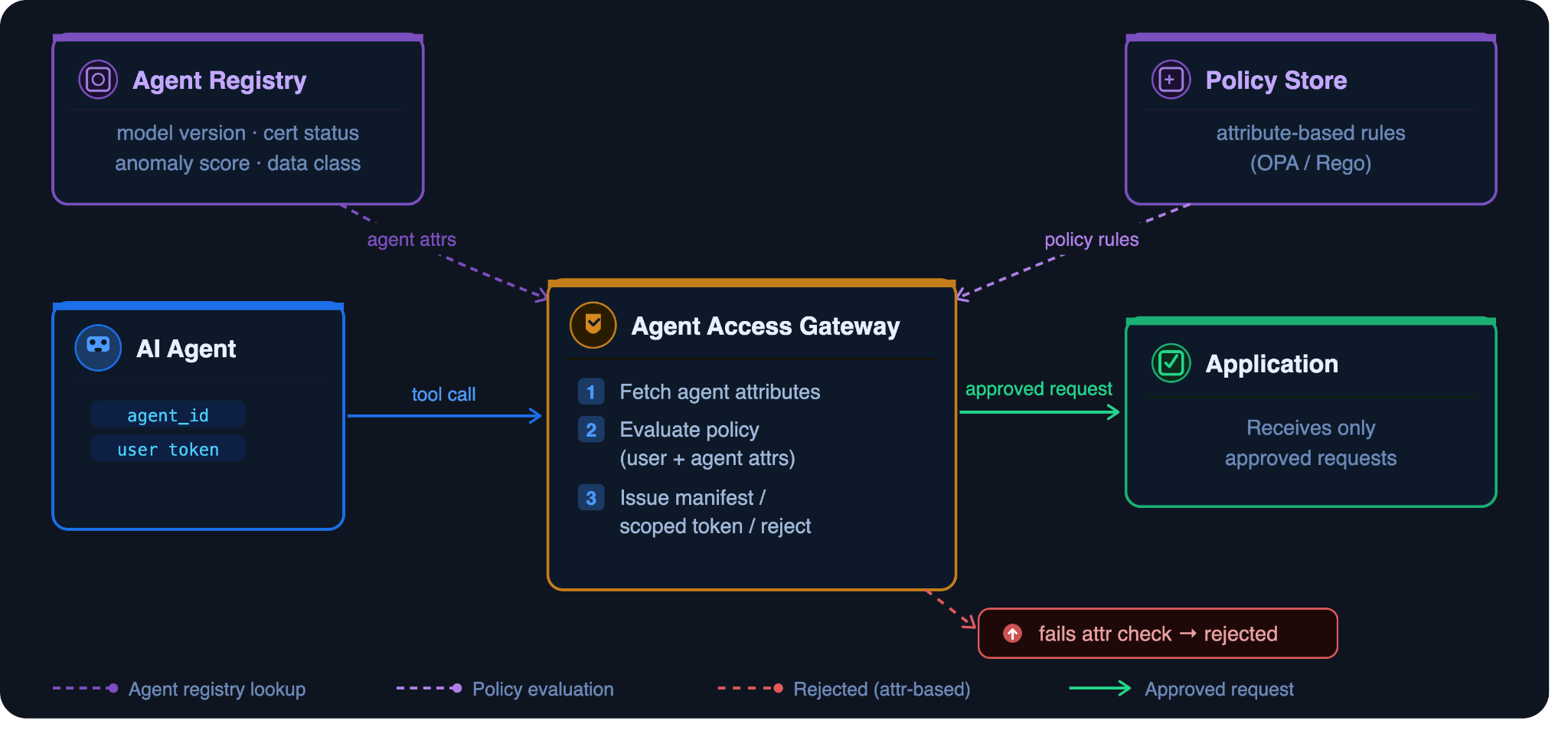
At this phase, Agent Access Gateway incorporates agent attributes into its policy evaluation. These attribute-based rules might look like:
- An agent running a model version that has not completed internal review is restricted to read-only tools regardless of user permissions.
- An agent not certified for PII access cannot receive a scoped token that includes fields classified as personally identifiable.
- An agent whose session anomaly score exceeds a threshold is downgraded to a reduced tool manifest for the remainder of the session.
- An agent operating under a verified, signed task specification from an approved orchestration system receives the full manifest its task requires.
Agent attributes are sourced from a lifecycle registry and evaluated at session establishment and, optionally, at each tool call.
|
Phase |
Control |
What It Enforces |
|
1 |
Credential Pass-Through |
Agent cannot exceed user's entitlements |
|
2 |
Tool Filtering |
Agent can only invoke tools in its issued manifest |
|
3 |
Token Exchange & Data Scoping |
Agent can only access data within the scoped token's claims |
|
4 |
Agent Lifecycle Attributes |
Access decisions incorporate agent certification state, model version, and anomaly signals |
Summary of Implementation Phases
Building the foundation for trusted agentic AI
By combining identity context, task intent, agent attributes, and runtime policy enforcement, Agent Access Gateway enables organizations to move beyond simple connectivity controls and toward true authorization for AI agents.
In the era of agentic AI, security is no longer about whether an agent can access a system. It's about ensuring every action aligns with the identity, intent, and context behind it.