Introduction: Trust Requires Evidence
Across industries — from healthcare to finance, retail to government — one theme cuts through every workshop I've facilitated with security leaders: AI will not be trusted unless it is auditable.
Saying "we govern AI" isn't sufficient. Boards, regulators, and customers are asking harder, more specific questions that demand concrete answers:
- Can you prove exactly what data the AI accessed and when?
- Can you show who is accountable for AI decisions that impact customers or operations?
- Can you trace how an AI agent produced its output, step by step?
Audit, compliance, provenance, and accountability are not nice-to-have features. They are the currency of trust in the AI era. Without these foundations firmly in place, AI adoption will inevitably stall no matter how powerful the underlying models become, or how compelling the business case appears.
The Audit Challenge: AI at Machine Speed
Traditional audit frameworks were built for human actors. We tracked logins, logouts, and access requests at a pace humans naturally operate. However, that entire model collapses when applied to AI agents.
Why does it fail? Because AI agents operate fundamentally differently: They act autonomously without a human in the decision loop. They chain multiple requests across applications in seconds rather than minutes. They call other agents and delegate tasks dynamically. They generate outputs that directly impact revenue, compliance, or safety — often without any human review.
A significant portion of organizations cannot fully trace how their AI models arrive at decisions. This should serve as a wake-up call. If a model makes a bad trade, recommends the wrong treatment, or leaks sensitive data, most companies today cannot reconstruct the sequence of events that led to the incident.
This creates a critical audit gap that most enterprises haven't addressed. To close this dangerous gap, enterprises need immutable audit trails specifically designed for AI operations.
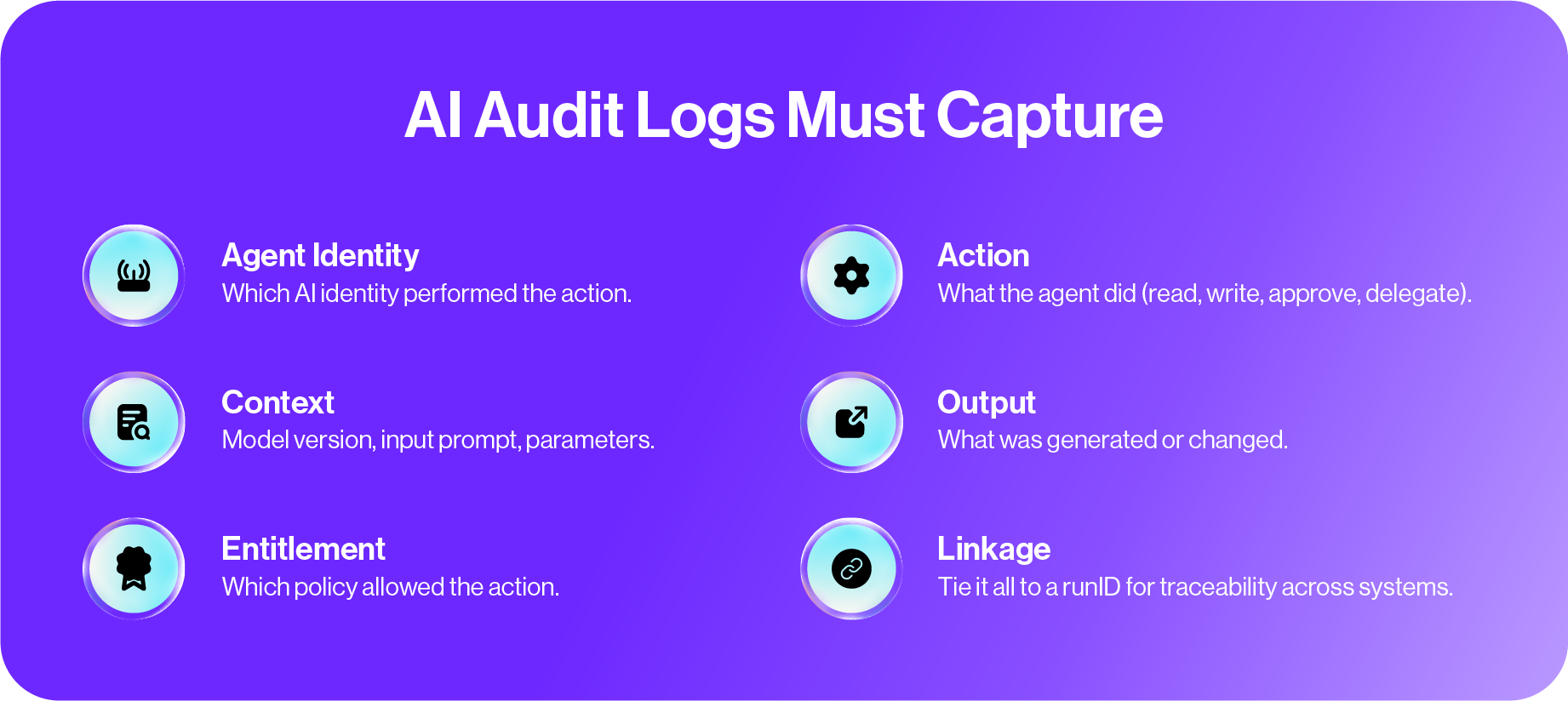
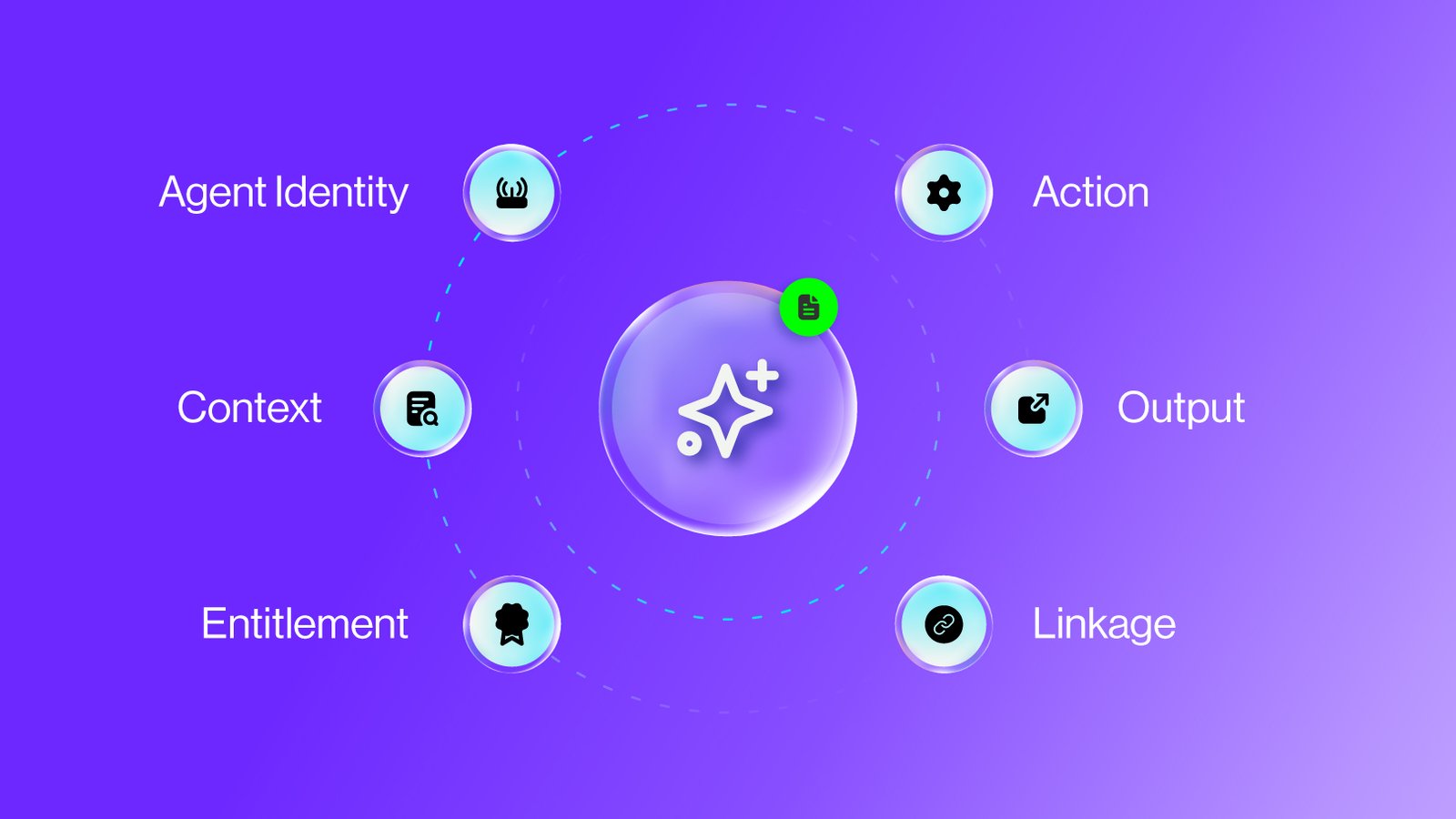
These logs must be tamper-proof. Without this protection, the entire audit trail becomes questionable.
Imagine being able to answer a regulator's question in seconds rather than days: "Yes, Agent Z ran version 4.2 of the model, on this specific dataset, at this timestamp, with these parameters, under this approved policy." That level of precision transforms defensive responses into confident demonstrations of control.
Every regulated industry is currently racing to interpret how existing compliance frameworks apply to AI systems — often without clear guidance from regulators themselves. Healthcare (HIPAA) requires proof that AI didn't leak protected patient information. Finance (SOX, Basel) demands evidence that AI didn't make unauthorized trades or financial commitments. Privacy (GDPR, CCPA) mandates proof that AI respects user consent and data minimization principles. Cybersecurity (NIS2, SEC rules) requires demonstration that AI agents were properly governed and monitored against attack scenarios.
How Comprehensive Audit Feeds Compliance
The mistake most enterprises make is treating "AI audit" as one undifferentiated bucket of telemetry — dump everything into a SIEM, keep it for a year, and hope it's enough when someone asks. It isn't, because auditors and regulators aren't asking one question. They're asking four different questions, and each one needs its own evidentiary trail:
Posture logs answer "what exists, and what shape is it in right now?"
This is your agent inventory — every agent, its owner, its entitlements, its risk score, whether it's drifted from its approved configuration. Without this, you can't even start a SOC 2 or ISO 42001 conversation, because you can't produce a scoped population to audit against. Most enterprises fail here first, not because posture is hard to log, but because shadow agents — spun up by a business team through a SaaS admin console or a low-code platform — never enter the inventory to begin with.
Lifecycle logs answer "was this agent legitimately brought into existence, and is it still legitimate?"
Registration, attestation, certification, recertification, decommissioning. This is the governance record — who approved this agent's existence, under what business justification, with what scope, and when was that approval last revalidated.
This is where SOX-style access certification logic extends naturally to agents: an agent's entitlements need periodic recertification the same way a human's do, and the lifecycle log is the proof that happened. Agentic certifications and doing at scale is a whole different topic which I will be writing about shortly and something we are working at Saviynt and very excited about.
Access logs answer "was this specific action authorized at the moment it happened?"
Every tool call, every API invocation, every data access — the runtime authorization decision, the policy that was evaluated, and the outcome. This is the layer Intent Aware Runtime Authorization (IARA) sits on: IARA means the access log isn't just "agent X called Salesforce API Y," it's "agent X, acting under scope Z, was evaluated against a specific entitlement boundary and permitted this specific transaction."
Provenance logs answer "why did the agent do what it did, and under what conditions?"
This is the hardest one, and it's where most solutions quietly stop, because it requires correlating the other three layers plus the reasoning trace itself.
The Regulatory Bar: Article 12 and 13 of the EU AI Act
The EU AI Act's Article 12 requires that high-risk AI systems technically allow for the automatic recording of events over the lifetime of the system — not just at deployment, but from first use through decommissioning. The logging is meant to support identifying inputs that cause unwanted behavior, drift detection for post-market monitoring, and ongoing monitoring of the system's operation. That's effectively posture, lifecycle, and access logs described in regulatory language rather than product language.
And critically, Article 13 goes further than Article 12 — it's not enough to record the decision, the system has to be designed so a human operator can actually understand the reasoning behind it, not just the outcome. A log with no explanatory chain is compliant with the letter of record-keeping and worthless for the oversight the regulation is actually trying to produce.
There's also a deployer-liability wrinkle worth putting directly in the piece: the deployer remains accountable for log retention and accessibility regardless of who built the underlying AI system. For example an Enterprise customer is running agents built on a third-party foundation model or orchestration platform, they don't get to point at the vendor when the regulator asks for the evidence — the burden sits with them. That's the strongest argument for a governance layer that sits above any individual agent framework and produces its own independent, correlated record, rather than depending on each agent vendor's own logging to be audit-grade.
One more detail worth landing: manual documentation — a human periodically reviewing AI outputs and writing notes — does not satisfy the automatic-recording requirement, and if logs can be silently altered without anyone noticing, their evidentiary value is effectively zero even though the regulation doesn't explicitly mandate tamper-proofing. This is why "regulator-ready evidence" has to mean something more specific than "we have logs" — it means the four streams are automatically generated, correlated to a common identity and session context, and integrity-protected end to end.
Provenance: Tracing the AI Decision Chain
The "what happened" question is comparatively easy — that's what access logs and posture logs already give you. Provenance is harder because it's not a single stream you can point a log aggregator at; it's a reconstruction. A defensible provenance record has to correlate at least four things at the moment of decision:
The identity chain
Not just which agent acted, but the full delegation lineage — human sponsor, parent application, agent, any sub-agent it spawned. If an agent operating on-behalf-of a specific employee approves a SAP purchase order, the provenance record has to show whose authority that action ultimately traces back to, not just which service account fired the API call. This is the distinction between OBO (on-behalf-of) and fully autonomous flows that matters enormously here: OBO provenance inherits and must record the human's entitlement boundary; autonomous provenance has to stand on the agent's own certified scope, because there's no human in the loop to inherit from.
The input context
What data, documents, or prior tool outputs informed the decision. If a Salesforce agent recommends a discount override, the provenance record needs to capture which account data, which pricing policy, and which prior interaction history it was reasoning over — not just the final recommendation. This is also where application-native, object-level context matters: a generic "the agent had CRM access" statement is not provenance; "the agent's recommendation was generated from these three opportunity records and this pricing rule" is.
The authorization trace
Which policy was evaluated, by which engine, and what the decision boundary was — this is where the access log and the provenance record meet. In IARA terms, this is "governing the governor": the runtime authorization decision itself becomes part of the thing being audited, not just the agent's action. If an auditor asks "why was this AWS IAM role assumption permitted," the answer can't be "the agent requested it and got a token" — it has to trace to the specific policy condition that evaluated true.
The model and configuration state
Which model version, which prompt/policy configuration, which tool definitions were active at that moment — because agent behavior isn't static, and "why did it do that" often resolves to "because that's what version 4.2 of the policy said to do, and it's since been changed."
Put together, provenance is the layer that turns "the agent took this action" into "the agent took this action, on behalf of this person, informed by this data, permitted under this policy, running this configuration" — which is the actual sentence a regulator, a plaintiff's attorney, or your own board wants when something goes wrong. A well-formed record should be able to state that a system produced a given decision at a given time, under a specific policy and model version, using specific inputs — and that the record hasn't been silently altered since. That's the bar. Posture, lifecycle, and access logs are the raw material; provenance is the synthesis that makes the raw material answer the question that actually gets asked.
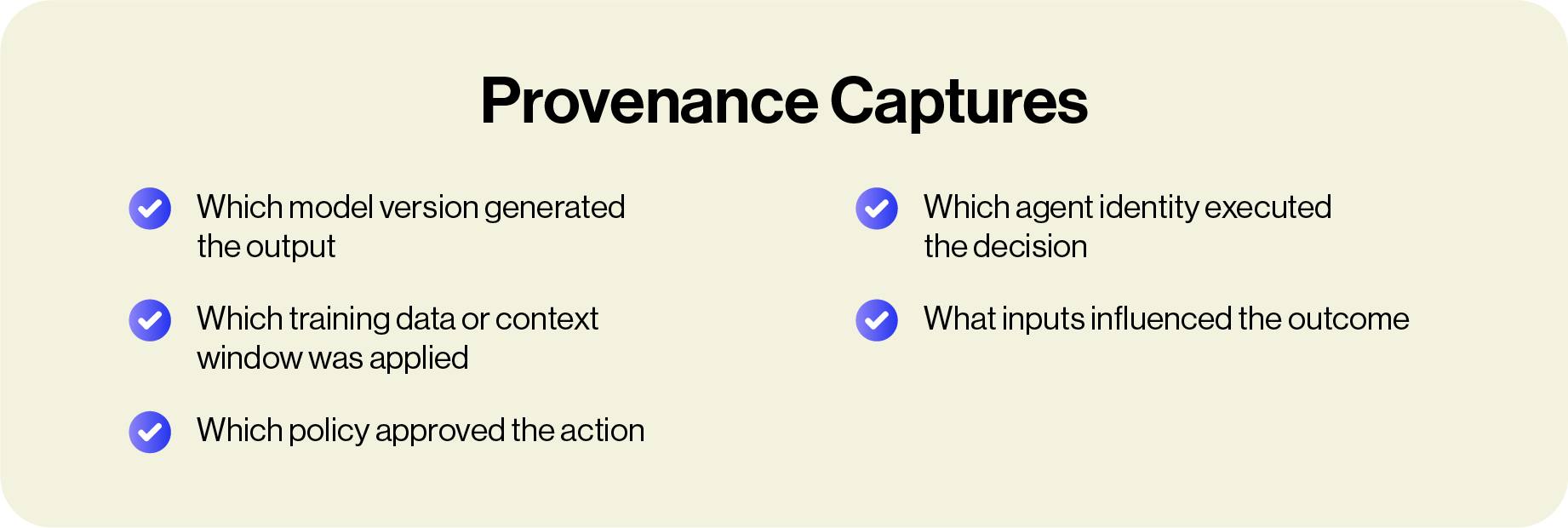
Here are some examples of where provenance matters:
In healthcare: "Which model version and what patient data influenced this treatment recommendation?"
In finance: "Which dataset and risk parameters influenced this credit score or trading decision?"
In retail: "Which policy and customer profile approved this personalized recommendation?"
Without comprehensive provenance, enterprises are defenseless against accusations of algorithmic bias, model hallucination, or systemic errors that harm customers or violate regulations.
Accountability: Who Owns AI Decisions?
This represents the toughest board-level question that security leaders face: If an AI agent misbehaves or causes harm, who is ultimately accountable?
The answer isn't simple, but it is structured: shared responsibility across multiple layers.
The enterprise is accountable for establishing and maintaining proper governance frameworks. The AI agent identity provides technical traceability through logs and audit trails. The designated human owner must provide oversight and accept responsibility for the agent's scope and behavior.
Accountability Framework
Every AI agent must have a registered owner who accepts responsibility. Every action must map back to an approved policy that authorized it. Every output must be explainable through provenance chains that show decision logic.
This framework doesn't eliminate risk—AI systems will make mistakes. But it makes risk manageable, defensible, and improvable through learning from incidents.
Why Audit & Provenance Resonate with CISOs and Boards
CISOs connect powerfully with this pillar because it speaks directly to the board's ultimate concern: "If AI misbehaves or causes an incident, can we prove what happened—and who is responsible?"
Boards don't want hand-waving or technical explanations they can't evaluate. They want evidence they can present to regulators or shareholders. Regulators don't want promises about what you'll do better next time. They want comprehensive logs that demonstrate what actually happened. Customers don't want theoretical commitments to responsible AI. They want transparency they can verify and trust.
That's why audit and provenance transform AI security from a technical concern managed by security teams into a strategic business imperative that boards must oversee directly.
The Currency of Trust
At the end of the day, AI security is not just about preventing breaches or blocking attacks. It's about building and maintaining trust with all your stakeholders—customers, regulators, employees, and investors.
Trust comes from evidence, not assertions. Evidence comes from comprehensive, immutable audit trails. Compliance readiness comes from logs that map directly to regulatory frameworks. Transparency comes from provenance chains that explain decisions. Responsibility comes from accountability frameworks that assign ownership.
When enterprises can produce this evidence on demand—quickly, completely, and convincingly—AI transforms from a powerful but scary technology into something far more valuable: a trustworthy strategic asset.
Because in the boardroom and the regulatory hearing room, trust isn't a marketing slogan or a mission statement. It's a ledger entry you can prove.
Series Conclusion: The Path Forward
Over the five blogs in this series, we've explored a complete framework for identity-driven AI governance:
Posture Management gives you visibility—the foundation for everything else. Lifecycle Management provides structure from registration to retirement. Access Management delivers runtime control over what agents can actually do. Audit and Provenance creates the evidence trail that builds trust.
Together, these five pillars form an integrated approach to making AI not just powerful, but governable. Not just innovative, but trustworthy. Not just deployed, but controlled.
The enterprises that implement this framework now — while AI adoption is still accelerating — will lead their industries with confidence. Those that wait will spend years playing catch-up, managing incidents instead of preventing them, and explaining failures instead of demonstrating success.
Start with discovery. You can't govern what you can't see — use posture management to inventory your AI agents today. Establish registration processes before the number of agents becomes unmanageable. Deploy access gateways while you still have the opportunity to get ahead of Shadow AI. Build your audit infrastructure before regulators demand it.
The question isn't whether AI will transform your business. It will (and already is). The question is whether you'll govern that transformation — or scramble to contain it after something goes wrong.
Identity is the operating system of AI security. It's time to treat it that way.
Miss a previous post? Check out the other series blogs:
Post 1 - Identity: The Operating System of AI Security
Post 2 - You Can’t Govern what you Can’t See - Posture Management for AI Agents
Post 3 - Identity Lifecycle Management for AI Agents — From Registration to Retirement
Post 4 - Securing AI Agents: Building Runtime Guardrails for the Autonomous Enterprise