When we introduced Agent Access Gateway earlier this year, a statement we heard often was, “We already have a gateway for AI.” But ask 10 security leaders what their AI gateway does and you’ll get 10 different answers: prompt filtering, MCP routing, model governance, OAuth scopes, runtime authorization, etc. They’re not wrong — they’re just describing different layers of the same stack and assuming one layer covers what the other two are built for.
Today, most organizations will have either a content security or routing gateway, but the critical piece to the puzzle is missing: access. Here’s what happens without a dedicated authorization layer: an AI agent can pass every security check you’ve deployed — clean prompt, approved connection, valid session — and still do something it was never supposed to do. It’s the predictable result of treating “AI gateway” as a single control instead of three distinct ones, each protecting a different layer.
The assumption that having a content or routing gateway secures AI activity is where risk hides.
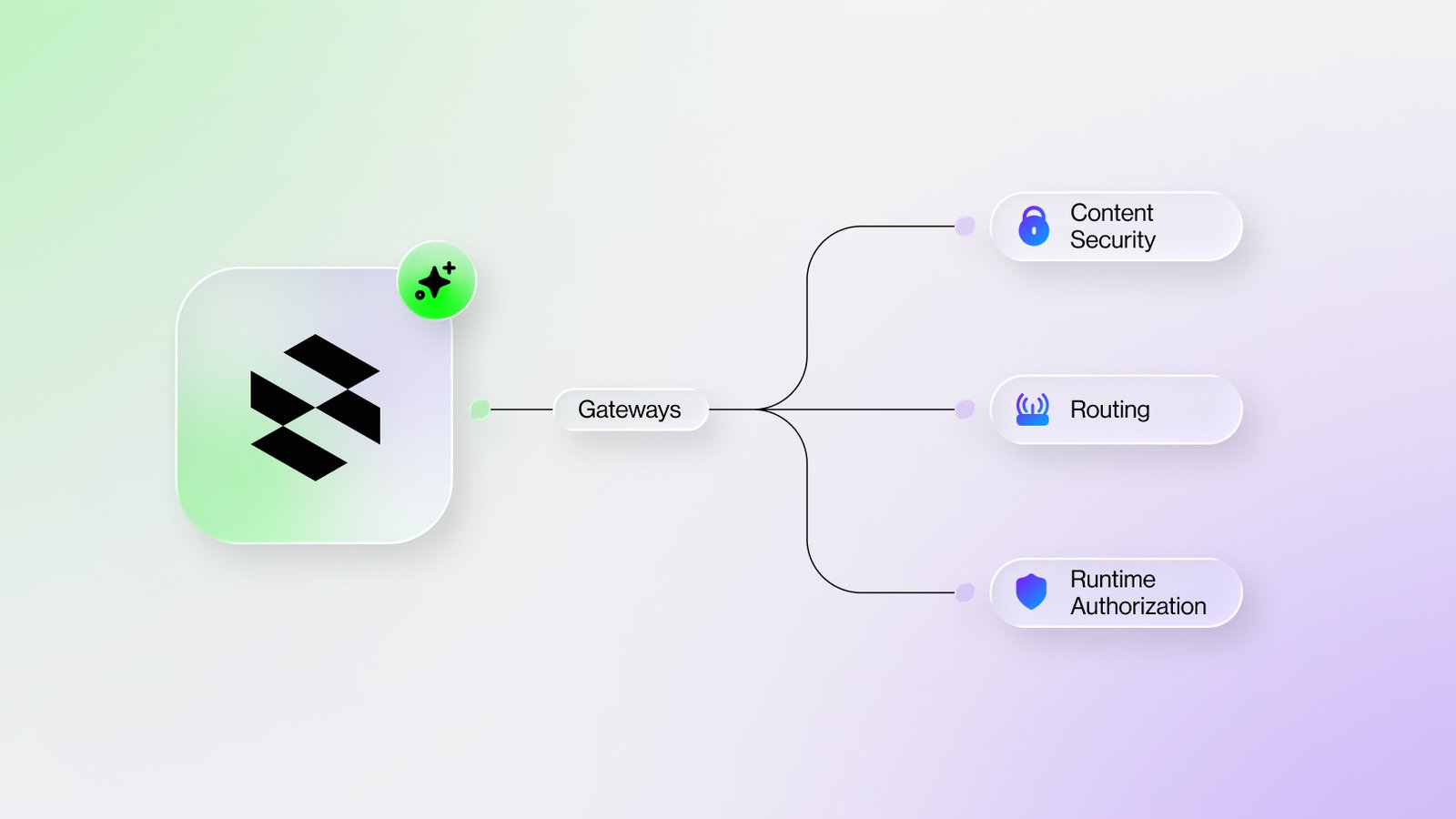
Three Questions, Three Gateways
Securing agentic AI means answering three distinct questions, in order, for every action an agent takes:
- Is this content safe?
- Can this agent reach this tool?
- Is this agent authorized to do this, right now, for this purpose?
None of the answers for the questions can be substituted for the others. Here’s how each gateway helps answer these questions and why all three gateways need to work in concert to provide effective AI security.
Gateway 1: Content Security. This is where most enterprises start, because it maps to the threat they understand best — bad prompts in, bad outputs out, and ensuring data isn’t going somewhere it shouldn’t. Content Security Gateways sit between users and the model, catching prompt injection, redacting sensitive data, and filtering harmful responses. It’s mature, necessary, and completely blind to identity. For example, a content security gateway can wave through a technically clean prompt from an agent that has no business querying that system in the first place.
Gateway 2: MCP & LLM Routing. As agents started calling tools, APIs, and models, a second gateway has emerged to broker those connections that approves MCP servers, enforces rate limits, and routes workloads to the right model. This gateway layer answers “can the agent reach the tool,” not “what can it do once it’s there.” Reaching a Workday MCP server isn’t the same as being entitled to compensation data. That gap is invisible to a routing gateway by design — governing connectivity was never its job.
Gateway 3: Runtime Authorization. This is the gateway layer neither of the first two can solve, but it’s where the real exposure lives. An agent can pass content inspection, and hold a valid tool connection, yet still take an action it was never entitled to take. Runtime authorization evaluates the agent’s identity, its declared intent, and the context of the specific action — continuously, not just at login — before an action executes.
Why “two out of three” fails
Each gateway guards one door. Deploying only a content or routing gateway – or both – creates the appearance of coverage while leaving the highest-risk layer – access – open. Consider an HR assistant agent, legitimately connected to Workday, with a valid session and a clean prompt. Content Security clears it. The MCP Gateway confirms the connection is sanctioned. Neither asks whether retrieving executive compensation records fits the task the agent was actually given. Only runtime authorization — evaluating intent against action, not just permission against endpoint — catches that.
This is also why agent identity has to work differently than user identity. Agents chain to other agents, accumulate permissions across delegation hops, and rarely go through the access reviews that would catch scope creep in a human workforce. Content and connectivity gateways have no visibility into any of that. It’s an identity governance problem, applied to a new class of principal. And it’s the reason runtime authorization must be built within identity governance foundations, not bolted onto a gateway that was never designed for it.
Saviynt Agent Access Gateway: The keystone of strong identity security for AI
Saviynt introduced the industry’s first Agent Access Gateway, with Intent-Aware Runtime Authorization (IARA), for continuous, identity-aware, context-sensitive authorization for AI agents.
Agent Access Gateway sits between agent clients and the MCP servers fronting your applications, evaluating every tool call against policy before it reaches the application by combining identity context, task intent, and governance signals. This is so agents are authorized not just to access a system, but to perform the specific action the task actually requires. It rolls out through four phases that meet organizations wherever they are today: binding agents to an owner’s own permission set, filtering the tools an agent can call, scoping data access through token exchange, and factoring an agent’s own lifecycle attributes such as model version, certification status, and anomaly signals into every decision.
Agent Access Gateway provides the layer content and connectivity gateways were never designed to support. It extends the same visibility, posture management, and lifecycle discipline you already apply to human identities across every AI agent and non-human identity in the enterprise.
The bottom line
Not being able to answer any of the three questions above is not an option, and none of these gateways can answer for another. Content Security protects the conversation. MCP and routing gateways protect the connection. And runtime authorization protects the action because it’s the layer where agentic AI either earns enterprise trust or quietly erodes it. All three should act as a single, coordinated governance fabric for secure AI adoption.
Organizations that have deployed one or two of these layers haven’t solved AI agent security. They’ve solved part of it and built false confidence around the part they haven’t.
For a deeper understanding of all three gateways, where each one fits, and how they prevent critical blind spots for AI agent identities, check out Saviynt Chief Product Officer, Vibhuti Sinha’s LinkedIn article.
For a greater look into why and how an access gateway is required to close AI control gaps, explore Saviynt Distinguished Software Engineer, Mahmoud Matouk’s post here.
Want to see Zuma Access and Agent Access Gateway in action? Join us for AI Security in Action: Saviynt Zuma to see intent-aware runtime authorization live.