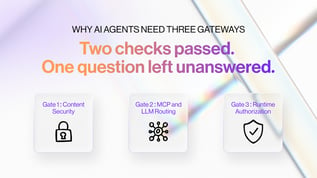
Learn About the Three Gateways Behind Secure AI Agent Adoption
Most organizations have already put a gateway in front of their AI. But ask 10 security leaders what that gateway does and you’ll get 10 different answers: prompt filtering, MCP routing, model governance, OAuth scopes. They’re all describing real controls. They’re just describing different layers of the same stack.
The risk shows up when one layer is assumed to cover the others. An AI agent can pass every check you’ve deployed, with a clean prompt, an approved connection, and a valid session, and still take an action it was never entitled to take. Content and connectivity controls weren’t built to ask whether that action is right for that agent, at that moment, for that purpose.
The Three Gateways framework infographic is a simple way to understand the distinct job each gateway performs, the question it answers, and why identity security for AI agents requires all three working together.
In this infographic, you'll learn:
- Why “we already have an AI gateway” doesn’t mean agent activity is covered
- The three questions every agent action should answer
- What content security, MCP and LLM routing, and runtime authorization each protect
- Why deploying only one or two gateways leaves the highest-risk layer, access, open
- How all three gateways work together as a single, coordinated governance fabric for secure AI adoption