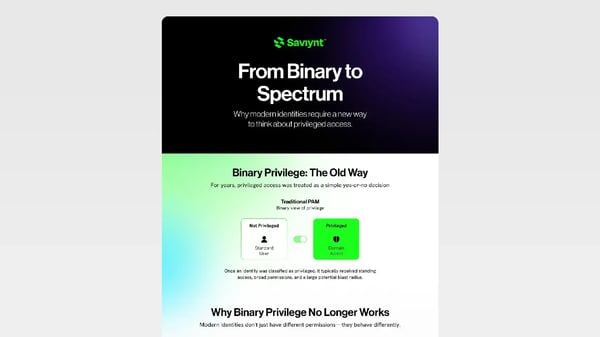
Why Modern Identities Require a New Way to Think About Privileged Access
For years, organizations treated privilege as a binary decision: an identity was either privileged or it wasn't. That model worked when privileged accounts were limited to administrators and a small number of service accounts.
Today's identity landscape is different. Human users, cloud workloads, service accounts, machine identities, and AI agents all operate with varying levels of access, risk, and autonomy. Applying the same controls to every identity creates unnecessary friction, while treating them all the same leaves critical gaps in security.
This infographic introduces The Privilege Spectrum—a modern framework for understanding privilege based on what an identity can do, not simply what type of identity it is.
In this infographic, you'll learn:
- Why the traditional binary view of privilege no longer reflects today's identity landscape.
- How modern identities exist across a spectrum of privilege, risk, and autonomy.
- Why privilege should be evaluated based on access and capabilities, not identity type.
- How Zero Standing Privilege, just-in-time access, and runtime authorization work together across the spectrum.
- A practical framework for applying the right level of protection to every identity, from human users to AI agents.