All AI agents are privileged identities. The question is how privileged.
AI agents are non-human identities (NHIs). Like service accounts, API keys, and machine credentials, they require access to enterprise systems, data, and applications to perform work. That means every AI agent operates with some level of privilege.
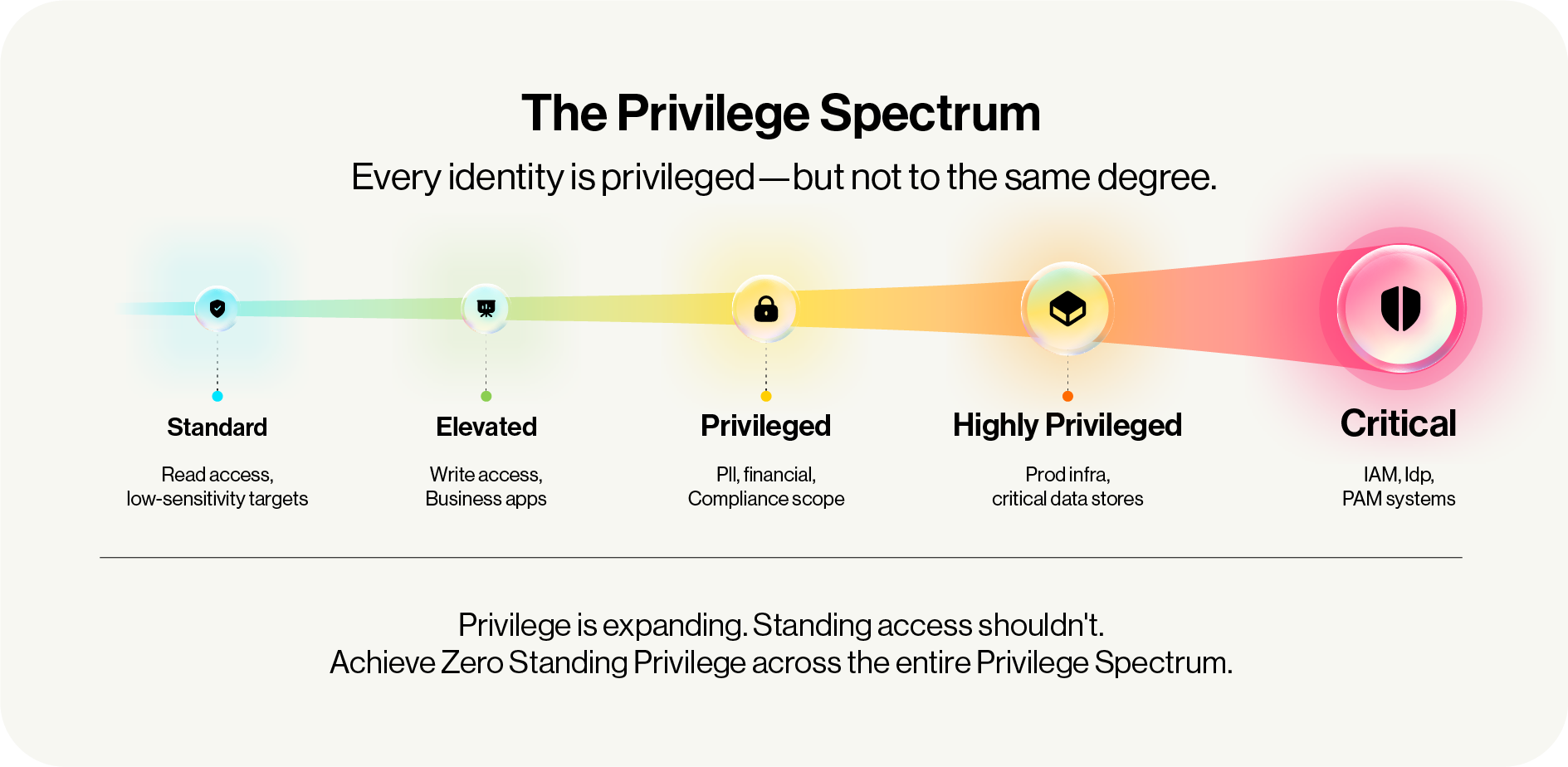
The mistake is treating privilege as binary — either an identity is privileged or it isn't. In reality, AI agents sit across a spectrum of privilege. A knowledge assistant that retrieves documents presents a very different risk than a financial agent that can move money or a DevOps agent that can deploy code. They are all privileged identities, but their authority and potential impact vary dramatically.
Understanding where agents sit on that privilege spectrum is becoming one of the most important challenges in AI identity security.
Autonomy changes the risk calculus
Traditional non-human identities derive risk from what they can access. AI agents pose risks through what they can access and what they choose to do.
A service account is largely deterministic. Its behavior is predictable, and its blast radius can be estimated from its permissions. AI agents are different. They operate toward goals, selecting tools, chaining actions across systems, and executing tasks with limited human oversight.
An overprivileged service account can expose data. An overprivileged AI agent can actively modify records, trigger workflows, move data between systems, and execute business processes at machine speed using legitimate permissions.
As Anthropic notes in its Zero Trust for AI Agents framework, the same autonomy that makes agents productive also makes them dangerous when manipulated. As a result, an agent's risk is determined not only by its permissions but also by its autonomy, connected tools, and runtime behavior. Privilege is no longer binary — it is dynamic and exists on a spectrum.
The threat landscape is already here
These risks are not theoretical.
In August 2024, a prompt injection embedded in a public Slack channel was ingested by Slack AI and executed when a user queried it. The result was unauthorized access to information stored in private channels using the agent's own legitimate permissions.
In May 2025, security researchers demonstrated how a malicious prompt hidden within a public GitHub issue could manipulate an AI coding assistant into exfiltrating sensitive repository data via a broad-scoped personal access token.
Neither attack required malware or credential theft.
Both relied on a simple reality: an AI agent was operating with more standing privilege than necessary and lacked sufficient controls to validate whether the requested action aligned with its intended purpose.
Privilege was always a spectrum. AI agents make that unavoidable.
Not all privileged identities carry the same risk. A read-only reporting account, a financial reconciliation agent, and a DevOps automation agent may all be privileged, but their authority and potential impact differ dramatically.
AI agents make these differences impossible to ignore. Applying the same controls to every agent either creates unnecessary friction for low-risk use cases or leaves high-risk agents overprivileged.
Instead, organizations must govern identities based on risk. That means evaluating factors such as system accessibility, data sensitivity, connected tools, autonomy, and runtime behavior. As Anthropic and OWASP's principle of "least agency" suggests, controls should extend beyond what an agent can access to what its tools are allowed to do, in what context, and for how long.
This risk-based approach shifts privilege from a binary decision to a spectrum and provides the foundation for implementing Zero Standing Privilege for AI agents.
What Zero Standing Privilege means for AI agents
Anthropic's framework offers a design test that should govern every control decision: does this make the attack impossible, or merely tedious? Friction-based controls, such as rate limits, credential rotation policies, and non-standard ports, degrade against adversaries operating at machine speed. The controls that survive the test share a pattern: expiring tokens, cryptographic identity, ephemeral authentication, and access paths that do not exist by default.
Every one of those controls is a PAM capability. The population they need to cover has expanded, but the controls themselves are not new.
The practical implication for Zero Standing Privilege is that its principles can no longer be reserved for the privileged few. AI agents dissolve the boundary between "high-risk identity that warrants scrutiny" and "routine identity that doesn't." Workforce productivity agents, application integration agents, and supply chain orchestrators wouldn’t traditionally be considered privileged. But under an agentic model, they gain the autonomous capability to cause significant harm through the legitimate use of granted permissions, directed by illegitimate instructions.
The rigor of Zero Standing Privilege must expand proportionately across the full identity estate. Not with uniform intensity (the spectrum governs that), but universally in principle. Verify every action. Grant minimum necessary permissions. Assume a breach has already occurred. These are no longer rules for the privileged tier. They are the governing standard for every active identity in the enterprise.
Why runtime authorization becomes critical
Implementing Zero Standing Privilege for AI agents requires more than just credential management. The challenge is that AI agents operate dynamically.
An agent may have legitimate access to a system. The more important question is whether the action it is attempting to perform should be allowed in that moment. This is where Agent Access Gateway becomes essential.
Runtime authorization evaluates access decisions using context. For example, an HR benefits agent may legitimately access Workday. However, if it suddenly attempts to retrieve executive compensation records or modify payroll information, Agent Access Gateway can detect that the action falls outside its intended purpose and block the request.
The decision is no longer based solely on whether the agent has access, but on whether the requested action aligns with intent, context, and policy.
The future of privilege management is dynamic
AI agents are forcing organizations to rethink assumptions that have governed identity security for decades. The question is no longer whether an identity is privileged. We must now consider how privileged it is, how much autonomy it possesses, and whether its actions remain aligned with business intent.
From discovery, the sequence follows the same logic PAM has always applied: understand what an identity can do, classify the risk it carries, bind controls proportionate to that classification, and continuously monitor runtime behavior. The difference is that classification must be dynamic, and monitoring must operate in near real time — because the window between a compromise and its consequences is measured in seconds, not days.
Privilege governance is one of those fundamentals. Build it into your agent architecture now. The enterprises that don't will discover (far too late) that their agents were privileged all along.