
Saviynt’s 2026 CISO AI Risk Report shows that 86% of organizations do not enforce access policies for AI identities. Ask your security team a simple question: Do you know how many AI agents are operating in our environment right now?
If the answer is a pause, a guess, or “we’re still working on that,” you’re not alone. AI agents are quietly becoming one of the largest and least governed workforces in the enterprise. They’re being spun up by developers, embedded in SaaS tools, and connected to sensitive systems, often with broad access, long-lived credentials, and no clear owner. Some are sanctioned. Many aren’t. This is shadow AI, and it’s a big part of why the number is so hard to pin down.
This is the identity blind spot, and it’s growing every quarter.
Why traditional identity governance wasn’t built for this
Identity governance was designed around people: employees who join, move, and leave, with managers who approve their access and periodic reviews that keep it in check.
AI agents and other non-human identities (NHIs) don’t follow that model. They don’t have managers or start dates. They can be created in minutes, act autonomously, chain together actions across systems, and persist long after the project that spawned them has ended. Add service accounts, API keys, bots, and machine credentials, and the number of non-human identities in most organizations already far outstrips the number of human ones.
When governance processes built for people are stretched over this new reality, the gaps appear fast:
- No inventory: You can’t govern what you can’t see.
- Unclear accountability: When an agent acts, who owns the outcome?
- Excessive access: Agents are often over-permissioned “just to make it work.”
- No lifecycle: Agents get created, but rarely reviewed or retired.
Shadow AI makes every gap worse
Those gaps exist for the agents security teams know about, and the ones they don’t. An employee connects an AI assistant to a shared drive. A team deploys an agent without a security review. A SaaS vendor adds AI features that act on your behalf. Each one is an identity with access, and none of them show up in your governance program.
That’s how the blind spot grows: not through one big decision, but through hundreds of small ones that happen outside the controls you already have.
Don’t wait for the blind spot to become a breach
AI adoption isn’t slowing down, and neither are the identities it creates. The organizations that get ahead of this now will be the ones that can adopt AI confidently, without sacrificing security or control.
Want to dive deeper? Join us on November 17.
On November 17, Saviynt and PwC are hosting a conversational webinar, “The Identity Blind Spot: Securing AI Agents and Non-Human Identities in 2027 and Beyond.”
Join us for a candid discussion about what’s really happening inside enterprises as AI adoption accelerates, and what leading organizations are doing about it.
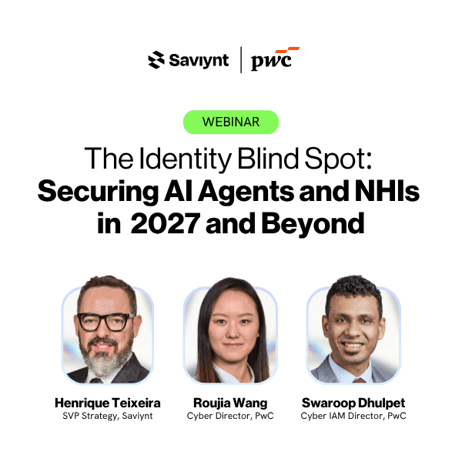
What you'll learn
- How AI adoption is reimagining identity security. What to expect as AI spreads across every function, and how to prepare now.
- Why AI agents deserve first-class identities. Why applying identity principles to agents matters for risk and compliance.
- Are “AI kill-switches” effective?. What are the best ways to implement guardrails and prevent organizations from unintended agentic AI behavior?
- Where is the money? Where should CISOs and identity leaders focus their investments for efficient and safe adoption of AI?
- Practical approaches to modernize Identity in 2027. Saviynt and PwC join forces to describe what is happening in practice, and what winning approaches should be prioritized in 2027 and beyond.
This session is for CISOs, identity and access management leaders, security architects, risk and compliance teams, and anyone responsible for how AI is adopted and secured in their organization.
Save your spot, register today!