Securing the AI Enterprise: An Identity-First Approach
Our last post covered Identity Lifecycle Management — governing AI agents from registration through retirement. But even properly registered agents with well-managed lifecycles can pose risks without runtime controls. This post explores the Access Management pillar: how to control what AI agents can actually do in real time and building the gateways that enforce policy at every action.
Introduction: How Do We Know AI Agents Are Doing What They’re Supposed to Do?
In nearly every CISO roundtable I’ve hosted over the past year, one question keeps surfacing with increasing urgency:
“How do we actually control what AI agents are allowed to do in real time?”
This question goes beyond discovering rogue agents or managing their lifecycle — topics I covered in previous posts. The real challenge lies in governing the moment-to-moment actions of legitimate AI agents already operating inside enterprise environments.
Consider the scenario:
You’ve discovered your AI agents through posture management. You’ve registered them through proper lifecycle governance. But then something unexpected happens.
An agent deployed to summarize customer tickets suddenly starts querying financial databases. Another agent designed to analyze code repositories attempts to push changes to production. A third agent begins calling APIs it was never intended to access.
Traditional IAM was built on a simple premise: authenticate once, then trust within defined boundaries. That model begins to break down with AI agents. They don’t just access systems — they take actions autonomously, chain requests across multiple systems in seconds, and evolve their behavior as new tools, plugins, or integrations are introduced.
The stakes are also very different. When a human user operates outside their intended scope, their activity typically unfolds at human speed and follows relatively predictable patterns. AI agents, however, can execute hundreds of unintended actions before traditional monitoring systems even detect something unusual.
This is where access management for AI fundamentally diverges from traditional access control.
It is no longer enough to know what an agent can do based on its provisioned permissions. Organizations must enforce what an agent should be doing based on its intended purpose — and those decisions must be evaluated in real time, action by action.
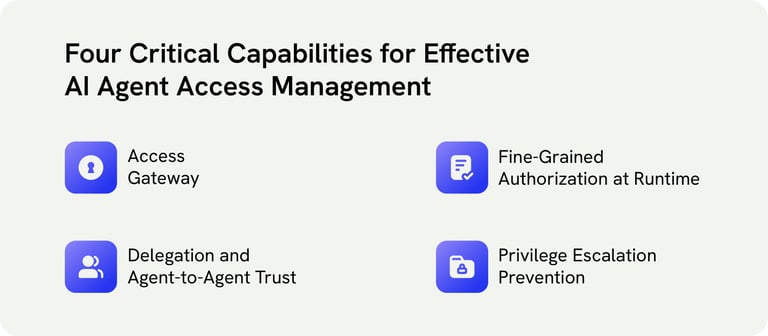
In this post, I’ll outline four critical capabilities organizations need to implement effective access management for AI agents — and why this challenge is quickly becoming one of the top concerns for CISOs.
#1 Access Gateway for AI Agents: Enforcing Identity and Access Controls at Runtime
Traditional IAM systems were designed around human access patterns — logins, sessions, and application access through SSO. AI agents operate very differently. They don’t authenticate through traditional login flows, they execute tasks autonomously, and they interact with multiple systems dynamically through APIs.
To securely govern these new identities, organizations need a runtime enforcement layer. Access Gateways act as a centralized control point between AI agents and enterprise systems, ensuring that every action performed by an agent is authenticated, authorized, and continuously evaluated against enterprise policy.
Key capabilities of Access Gateways include:
Agent Authentication and Registration Validation
Before an AI agent can access enterprise resources, the Access Gateway verifies the agent against agent registration and the ownership registry. Only registered and governed agents are allowed to operate. If an agent cannot be validated, access is immediately denied.
Context-Aware Policy Enforcement
Access Gateways evaluate access requests using contextual signals such as the requesting agent, requested resource, execution time, environment, and policy conditions. This allows organizations to define policies that go beyond static permissions — for example allowing an agent to retrieve CRM insights during business hours while automatically blocking access outside approved windows.
Runtime Authorization for Every Action
Unlike traditional IAM systems that validate access only at login, an Access Gateway performs transaction-level authorization checks. Each API call or action initiated by an AI agent is evaluated in real time, ensuring agents operate within the intended scope and preventing unauthorized or unintended actions.
Intent-Aware Authorization (Learn more about this in detail in my upcoming blog about building intent aware agent gateways)
AI agents do not simply execute deterministic commands — they pursue goals and dynamically determine the steps required to achieve them. Access Gateways can evaluate the intent behind an action by analyzing prompts, execution plans, and the chain of actions an agent is attempting to perform. This allows policies to govern not just what an agent can access, but whether the action aligns with the intended purpose. For example, an agent tasked with summarizing customer records should not suddenly attempt bulk deletion of those records.
Secure Delegation and Scoped Token Management
When agents invoke other services or agents, an Access Gateway issues short-lived, scoped tokens to limit privilege propagation. This prevents uncontrolled privilege chaining and ensures that delegated access remains tightly bound to the specific task being executed.
#2 – Fine-Grained Authorization at Runtime
Traditional identity systems rely heavily on static roles, which work reasonably well for human users with predictable access patterns. AI agents, however, operate very differently. They dynamically determine actions based on goals, prompts, and changing context. As a result, their access cannot be governed through static role assignments alone.
Instead, access decisions must be evaluated dynamically at runtime, with policies that assess each action an agent attempts to perform.
Examples of fine-grained authorization include scenarios such as:
- Agent X being allowed to read invoice data but not approve payments
- Agent Y summarizing EHR clinical notes but not downloading complete patient histories
- Agent Z updating CRM contact fields only during approved business hours in the user’s time zone
Implementing this level of control requires policy-driven authorization models that go beyond traditional role-based access. Common approaches include:
Attribute-Based Access Control (ABAC)
Authorization decisions are made by evaluating contextual attributes such as the requesting identity, the resource being accessed, time of access, data sensitivity, ownership, and environment conditions.
Policy-Based Access Control (PBAC)
Centralized policy frameworks allow organizations to define and enforce enterprise-wide access policies consistently across applications, APIs, and data services.
Policy Decision Engines (e.g., Open Policy Agent)
Policy engines evaluate authorization policies at runtime and return allow/deny decisions for each request. These engines enable consistent enforcement of fine-grained access policies across distributed systems and API-based architectures.
#3 – Delegation and Agent-to-Agent Trust
AI agents rarely operate in isolation. To complete complex workflows, agents often invoke other agents or services, each with different capabilities and levels of privilege.
Consider a simple example:
-
Agent A acts as a developer assistant that helps write code.
-
Agent B functions as a deployment manager with access to deployment pipelines.
If Agent A attempts to trigger a deployment through Agent B, the system must ensure that Agent A does not unintentionally inherit full production deployment privileges. Without proper controls, these interactions can create privilege escalation through capability chaining, where one agent indirectly gains access to actions it was never intended to perform.
To safely enable collaboration between agents, systems need controlled delegation mechanisms.
Delegation Tokens provide this control by allowing an agent to perform a narrowly scoped task on behalf of another process without inheriting unrestricted privileges. These tokens are:
- Capability-scoped — limited to specific actions such as deploying to a staging environment rather than production
- Short-lived — issued with strict time-to-live (TTL) expiration to minimize risk
- Policy-governed — generated through a central authorization service based on defined enterprise policies
- Gateway-validated — verified by the Access Gateway before any delegated action is executed
This approach allows agents to collaborate and complete multi-step workflows while ensuring that privileges remain bounded, traceable, and aligned with enterprise security policy.
#4 – Preventing Privilege Escalation
Privilege escalation represents one of the most serious risks in AI-driven environments. It can occur silently, propagate quickly, and significantly expand an agent’s ability to access systems or perform sensitive operations.
Unlike human users — where privilege creep typically happens gradually — AI agents can gain new capabilities almost instantly through tool additions, plugin integrations, configuration changes, or expanded API access. These changes can unintentionally introduce privileges that were never formally reviewed or approved.
Consider a simple example:
A customer support agent is initially granted read-only access to customer records so it can answer user questions. Later, a plugin is added that allows the bot to modify customer profiles. Without proper governance and policy checks, the bot now has write access to sensitive data, introducing risk that was never assessed during its original deployment.
Preventing these scenarios requires several key controls:
Runtime Policy Enforcement
Access decisions should be evaluated dynamically at runtime. The gateway verifies every action against current enterprise policies, ensuring that newly introduced capabilities do not automatically translate into expanded privileges.
Continuous Privilege Drift Detection
Security systems must continuously monitor agent permissions and capabilities. If an agent’s effective privileges deviate from its approved scope — due to integrations, configuration changes, or new tools — the system should automatically flag or restrict the agent for review.
Dynamic Revocation and Containment
Organizations must be able to immediately revoke tokens, terminate sessions, or disable agents if suspicious behavior or unexpected privilege expansion is detected.
In most cases, the problem is not malicious intent but uncontrolled capability growth. As AI agents evolve and integrate with more systems, access governance cannot remain static. In an AI-driven environment, access decisions must be continuous, contextual, and revocable.
Saviynt's New AI Access Management Architecture
Here's a look at how Saviynt's Intent-Aware Authorization Gateway delivers the runtime enforcement architecture that enables a fundamental shift from static, policy-set-it-and-forget-it controls to continuous, intent-aware authorization for every action AI agents take.
.png?width=674&height=379&name=image%20(3).png)
AI Agents (Procurement, HR, Finance, IT Ops, and other enterprise agents) connect to the Saviynt Gateway that evaluates every agent action in real time, before an action is taken.
The Gateway runs three checks: Intent Analysis to determine what the agent is trying to accomplish; Context Evaluation to assess whether the action matches the approved mission scope; Policy Enforcement to apply least-privilege and risk thresholds. Only then is a decision to take an action is mad - Allow, Block, or Escalate with a fully logged audit trail.
Only if the action is permitted does the Gateway allow access to flow through to enterprise systems — including Salesforce, SAP, AWS, Google Drive, and other connected SaaS and cloud applications — backed by three core principles: Provenance (every action tied to a verified agent identity in Saviynt IGA), Zero Standing Permissions (just-in-time access scoped to each task), and a Real-Time Risk Engine (behavioral analytics that detect anomalies before damage occurs).
This architecture transforms access control from a binary gate (logged in or not) to a continuous evaluation engine.
Why Access Gateways resonate with CISOs
Access gateways resonate powerfully with security leaders because it feels immediate and tangible. Posture management and lifecycle governance are strategic initiatives that deliver value over time. But Access Gateways are tactical controls that give CISOs operational control right now, today.
CISO’s lean into this approach because Access Gateways dramatically reduce AI risk by centralizing enforcement. They provide an effective kill switch for immediate response to threats. They deliver detailed audit trails that regulators and compliance teams value highly.
One CISO captured the appeal perfectly: "This is what lets me sleep at night. Every AI call gets checked against policy in real time. I'm not hoping agents behave, I'm enforcing it."
Conclusion: Building the Runtime Guardrails for AI
Static access models were designed for predictable human behavior. They struggle to keep pace with AI agents that act autonomously, interact with multiple systems, and dynamically determine the actions needed to achieve a goal.
Traditional authentication alone is no longer sufficient. Even maintaining an inventory of registered agents is not enough if their actions are not continuously governed.
Securing AI-driven environments requires access management controls designed for runtime decision-making, including:
- Access Gateways that serve as centralized enforcement points, evaluating every action an agent attempts to perform
- Fine-grained, contextual authorization that considers real-time conditions such as the requesting agent, resource sensitivity, environment, and timing
- Delegation controls that govern how agents invoke other agents or services without enabling uncontrolled privilege propagation
- Continuous monitoring and dynamic revocation to detect and prevent privilege drift, suspicious behavior, and immediately restrict access when necessary
If traditional IAM was primarily about “who can log in,” AI access management becomes a more continuous question:
“What is this agent trying to do right now — and should it be allowed to proceed?”
Building these runtime guardrails will be essential for organizations that want to safely scale AI while maintaining the governance, visibility, and control expected in enterprise environments.
This isn't just IAM 2.0 or an incremental evolution. It's the linchpin of AI governance. And without it, risk that will eventually materialize into real incidents.
Up Next: In our final post, we'll explore what transforms AI governance from a security initiative into strategic trust: Audit, Compliance, Provenance, and Accountability. Because in the boardroom, trust isn't a promise — it's evidence you can prove.
As always, thanks for reading!
Miss a post? Check out the other blogs in the series:
Post 1 - Identity: The Operating System of AI Security
Post 2 - You Can’t Govern what you Can’t See - Posture Management for AI Agents
Post 3 - Identity Lifecycle Management for AI Agents — From Registration to Retirement
Post 5 - Audit, Compliance, Provenance & Accountability of AI Agents — The Currency of Trust in the Age of AI