Discover privileged access and establish ownership, including for unmanaged credentials.
We’re excited to share that Saviynt has been named a Challenger in the 2026 Gartner® Magic Quadrant™ for Privileged Access Management. Saviynt was recognized as an Honorable Mention in 2024, and was positioned in the Challengers quadrant in 2025. We believe this momentum and placement reflects Saviynt’s modern approach to PAM as privileged access extends beyond human administrators, and demands tighter identity governance controls for ownership and remediation.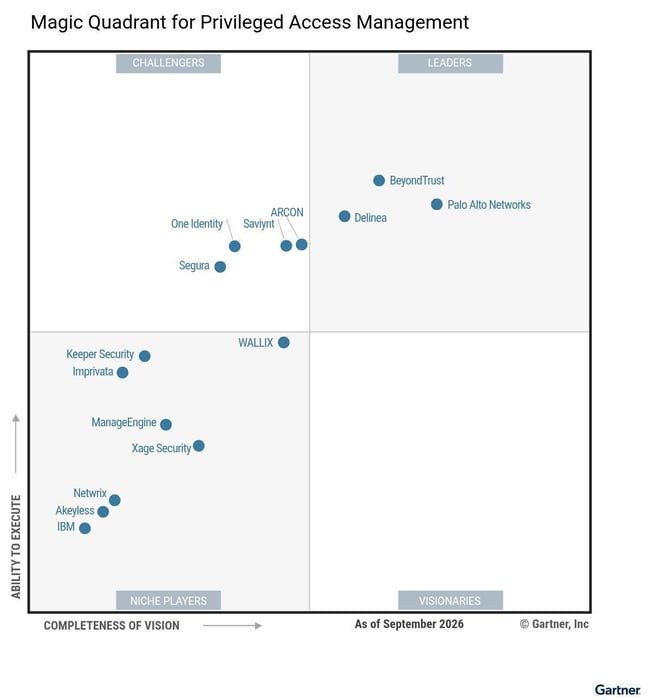
This recognition comes at an important time for PAM. AI is an identity problem. AI agents and their associated machine credentials are carrying too many privileges without clear human ownership and accountability. Cloud workloads, non-human identities, and AI agents increasingly require powerful access to do their work, changing both where privilege exists and how quickly it can be exercised. Privilege is expanding. Standing access, and lack of accountability, shouldn’t.
Saviynt solves privilege with market-leading identity lifecycle management
Saviynt’s Privileged Access Management (PAM) and Identity Governance and Administration (IGA) are built together within a single, unified platform—where Saviynt IGA is the only product which has ever earned the Gartner Customers' Choice award five consecutive times. Beyond managing individual sessions, organizations must actively discover privileged access, assign clear ownership, and verify whether the initial business justification still applies. Without proper oversight, unowned credentials or leftover permissions from previous roles can persist indefinitely, even when session lengths are strictly controlled.
We believe effective privileged access management requires managing privilege throughout its lifecycle, before, during, and after access is granted.
Organizations using both Saviynt PAM and Saviynt Identity Governance and Administration (IGA) can connect these controls to broader identity lifecycle processes. A role change, approval, or certification can then inform whether privileged access should be granted or retained. That governance context helps put Saviynt’s Zero Standing Privilege goal into practice across more than individual privileged sessions.
Modern privileged access needs to be simple and reliable.
Saviynt combines AI-driven capabilities with experience supporting complex enterprise deployments to simplify privileged access management and reduce operational overhead. Backed by world-class customer support and an established presence in enterprise identity security, Saviynt is committed to helping organizations meet evolving privileged access requirements.
A cloud workload can run on a schedule and use elevated access at machine speed. An AI agent may choose which authorized tools to use and take actions across several systems as it completes a task. Those patterns make it harder to rely on controls built around a human requesting access, signing in, and ending a session. Teams need to know which identity is acting, what actions its permissions allow, and how to limit or stop that authority as the work unfolds.
The goal is consistent across identity types, even when the controls differ. Privileged access should be tied to a defined purpose and reviewed against what the identity is doing, with a clear way to remove it when that purpose ends.
Standing privilege becomes harder to justify as access changes
A privileged credential can be securely stored and monitored while the authority it unlocks remains available around the clock. Protecting the credential does not limit when its permissions can be exercised. Access granted for occasional work may therefore remain available between tasks.
The 2026 Gartner PAM evaluation includes just-in-time (JIT) provisioning and ephemeral credentials among the capabilities it considers. JIT provisioning grants elevated access for a defined task and period, then removes it. Ephemeral credentials limit how long an identity can use a particular secret. Together, these controls address the duration of privilege as well as the protection of the credential itself.
Saviynt’s goal is Zero Standing Privilege (ZSP): remove persistent elevated access wherever the work allows it. Some services still need ongoing permissions to function. Those permissions should have a clear owner and purpose, remain narrowly scoped, and be monitored as the service’s needs change.
The Privilege Spectrum is fundamental to bring ZSP into the reality of AI
Zero Standing Privilege sets the direction: remove persistent elevated access wherever possible. Saviynt’s Privilege Spectrum is the approach that helps modern organizations to get there. An identity’s type alone does not tell the whole story. Security teams need to consider the task, the authority it requires, the context in which it occurs, and whether the identity can act autonomously.
A machine workload or AI agent may need basic read access for routine checks and elevated permissions for a deployment. That higher authority should be available only for the deployment, not throughout the time between releases. An administrator performing maintenance and an AI agent taking a sensitive action may also need different approval, monitoring, or enforcement controls, even when both receive access for a limited period.
The point of the Privilege Spectrum is to calculate and match the control to the privilege being exercised. Ownership establishes accountability; lifecycle and access limits govern when authority is granted; monitoring and threat detection show how it was used. The Privilege Spectrum helps teams apply those controls adjusted to risk, while ZSP keeps the focus on the goal of reducing long-standing privileges.
Govern privilege as the work changes
We feel Saviynt’s recognition as a Challenger in the 2026 Gartner® Magic Quadrant™ for Privileged Access Management gives readers an opportunity to examine its position in the broader PAM market. We believe the research’s attention to changing privileged-access needs makes the question behind Saviynt’s approach especially relevant: How can organizations give human, machine, and AI identities the authority their work requires without leaving elevated access in place between tasks?
Saviynt PAM helps organizations limit and manage that access. And Saviynt also made sure to build its PAM capabilities as a part of a broader identity, lifecycle and cybersecurity ecosystem. For those also using Saviynt IGA, connected lifecycle and governance processes add context to decisions about who or what should retain privilege.
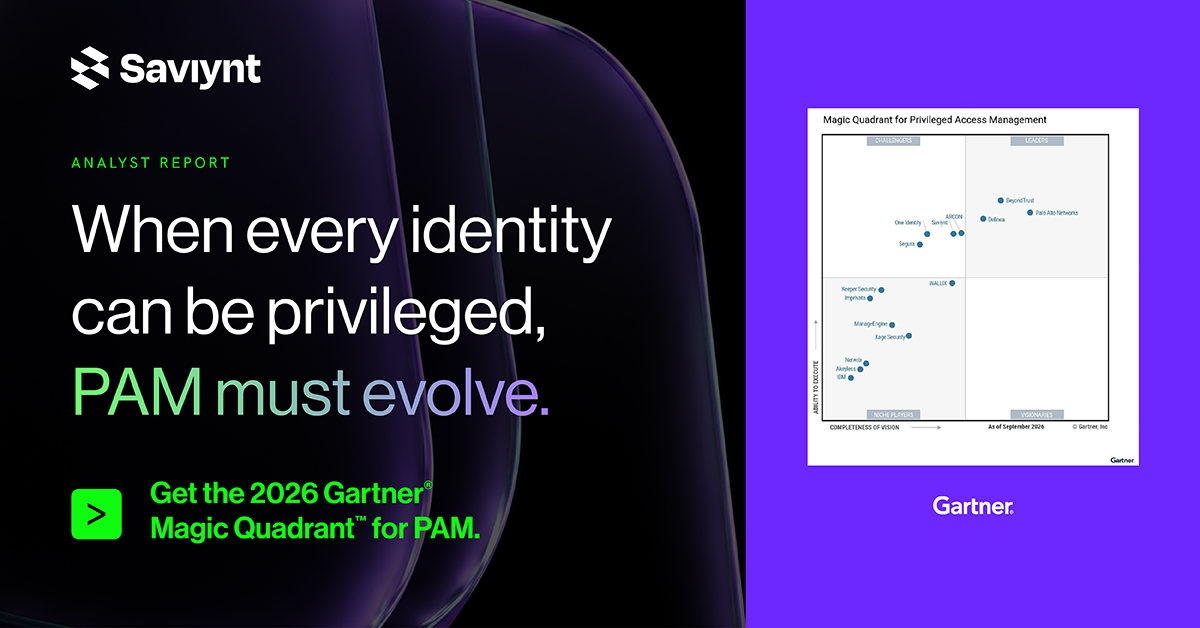
Access the 2026 Gartner® Magic Quadrant™ for Privileged Access Management to explore the evolving PAM landscape and learn why Gartner positioned Saviynt as a Challenger.
Disclaimer
Gartner, Magic Quadrant for Privileged Access Management, Paul Mezzera, Shubham Gera, Scott Brinker, Tarun Rohilla, 21 October 2026
GARTNER is a registered trademark and service mark of Gartner, Inc. and/or its affiliates in the U.S. and internationally, and MAGIC QUADRANT is a registered trademark of Gartner, Inc. and/or its affiliates and are used herein with permission. All rights reserved.
Gartner does not endorse any vendor, product or service depicted in its research publications, and does not advise technology users to select only those vendors with the highest ratings or other designation. Gartner research publications consist of the opinions of Gartner’s research organization and should not be construed as statements of fact. Gartner disclaims all warranties, expressed or implied, with respect to this research, including any warranties of merchantability or fitness for a particular purpose.
This graphic was published by Gartner, Inc. as part of a larger research document and should be evaluated in the context of the entire document. The Gartner document is available upon request from Saviynt.