Executive summary
Traditional privileged access management (PAM) was built for a smaller, more predictable set of administrator and technical accounts. Modern enterprises now depend on workforce users, service accounts, cloud workloads and AI agents that can all hold consequential access, with widely different levels of authority, autonomy and potential impact.
The privilege spectrum offers a more precise way to understand these differences and apply controls in proportion to risk. This approach extends zero standing privilege beyond traditional administrator accounts while giving organizations a more consistent way to govern consequential access across every identity type.
Key takeaways
- Privilege now extends across human, nonhuman, cloud and AI identities, each with a different level of authority and risk.
- Identity type alone cannot determine how much privilege an identity holds or which controls it requires.
- AI agents expose the limits of binary classification because their access and autonomy can vary widely.
- A spectrum model helps organizations evaluate privilege according to actual authority and potential impact rather than relying on identity type.
- Zero standing privilege should extend beyond administrator accounts with controls that become stronger as privilege and risk increase.
For years, privileged access management began with a simple question: Is this identity privileged? That question worked when elevated access was concentrated among administrators, root accounts and a limited number of technical identities. Security teams could draw a clear line between ordinary users and the accounts that required stronger controls.
That line has blurred. Workforce users can approve payments or access sensitive employee data. Nonhuman identities and cloud workloads can operate across critical systems without direct human oversight. AI agents can inherit permissions, connect to multiple tools and act autonomously at machine speed.
Each of these identities carries a different combination of authority, autonomy and risk. That risk depends on what the identity can access, the actions it can take, how independently it operates and the consequences of misuse. The better question is no longer whether an identity is privileged. It is how privileged that identity is.
The binary model served its purpose
Traditional privileged access management was built around identities that were relatively easy to recognize. Root accounts, domain administrators, database administrators and break-glass accounts held broad technical authority, often over systems that could affect the entire enterprise. Because that population was limited and well-defined, security teams could apply stronger controls to those high-risk accounts.
Credential vaulting reduced direct exposure to passwords. Rotation limited how long a credential remained valid. Approval workflows added oversight before access was granted, while session monitoring created a record of privileged activity. In that environment, this model was practical and effective.
The limitation came from the assumption behind those controls: meaningful privilege belonged to a small, stable group of technical accounts. That is no longer the case. Sensitive access now extends across business applications, automated processes, cloud workloads and AI systems, where authority may be distributed, temporary or difficult to classify using a binary label.
The identity landscape has outgrown the binary model
Privilege now extends far beyond the administrator accounts at the center of traditional PAM. Workforce and business users, nonhuman identities, service accounts, cloud workloads and AI agents can all hold access with meaningful consequences. Yet identity type alone says little about the level of risk.
An HR employee may be able to change payroll records or executive compensation. A marketing manager may have access to customer data, campaign budgets and confidential launch plans. A service account may retain broad permissions long after its original owner or purpose has disappeared. A cloud workload may create resources, assume production roles or move data across environments. An AI agent may combine sensitive access with the ability to act independently.
The level of privilege depends on the scope of access, the sensitivity of the data involved, the actions the identity can perform and whether it operates autonomously. Duration, potential blast radius and current risk signals may also change the controls it requires.
Privilege exists wherever an identity can materially affect systems, data, transactions or business outcomes.
AI agents reveal the limits of binary privilege
AI agents make the limits of binary privilege easier to see. They often inherit permissions from the users, applications or service identities connected to them. They can act continuously, execute at machine speed and complete tasks without pausing for direct human confirmation.
Their authority can vary widely. An assistant who summarizes approved documents may have narrow, read-only access. A coding agent may modify repositories and trigger development workflows. A financial agent may review transactions, update accounting records or interact with payment systems. Their shared classification as AI agents says little about the risk each one presents.
Autonomy can also increase effective privilege. An identity that can decide and act on its own may create more risk than one with similar access that requires a person to initiate every step.
Humans, service accounts and cloud workloads have long carried different degrees of privilege within the same broad category. AI makes that mismatch harder to overlook and raises the risk of applying controls that do not reflect an identity’s authority.
Binary privilege creates both friction and exposure
A binary model often disconnects security controls from the risk of the task. Routine activity can become trapped in approval processes designed for highly sensitive access, slowing lower-risk work and encouraging users to look for shortcuts. Security teams also spend time reviewing requests that could be handled through narrower, automated policies.
Consequential access may also receive too little scrutiny when the identity does not fit a traditional privileged category. A business user with access to sensitive financial or customer data may still be treated as an ordinary user. A service account may keep standing access because it is not classified as an administrator. An AI agent may receive broad application access without controls over the specific records it can view or actions it can take.
Privilege also changes over time. It may increase when an identity receives a new role, connects to another system, gains access to more sensitive data, or begins acting autonomously. The same identity may require different controls for different tasks.
A two-category model cannot adjust consistently as an identity’s access, autonomy and risk change.
Privilege is better understood as a spectrum
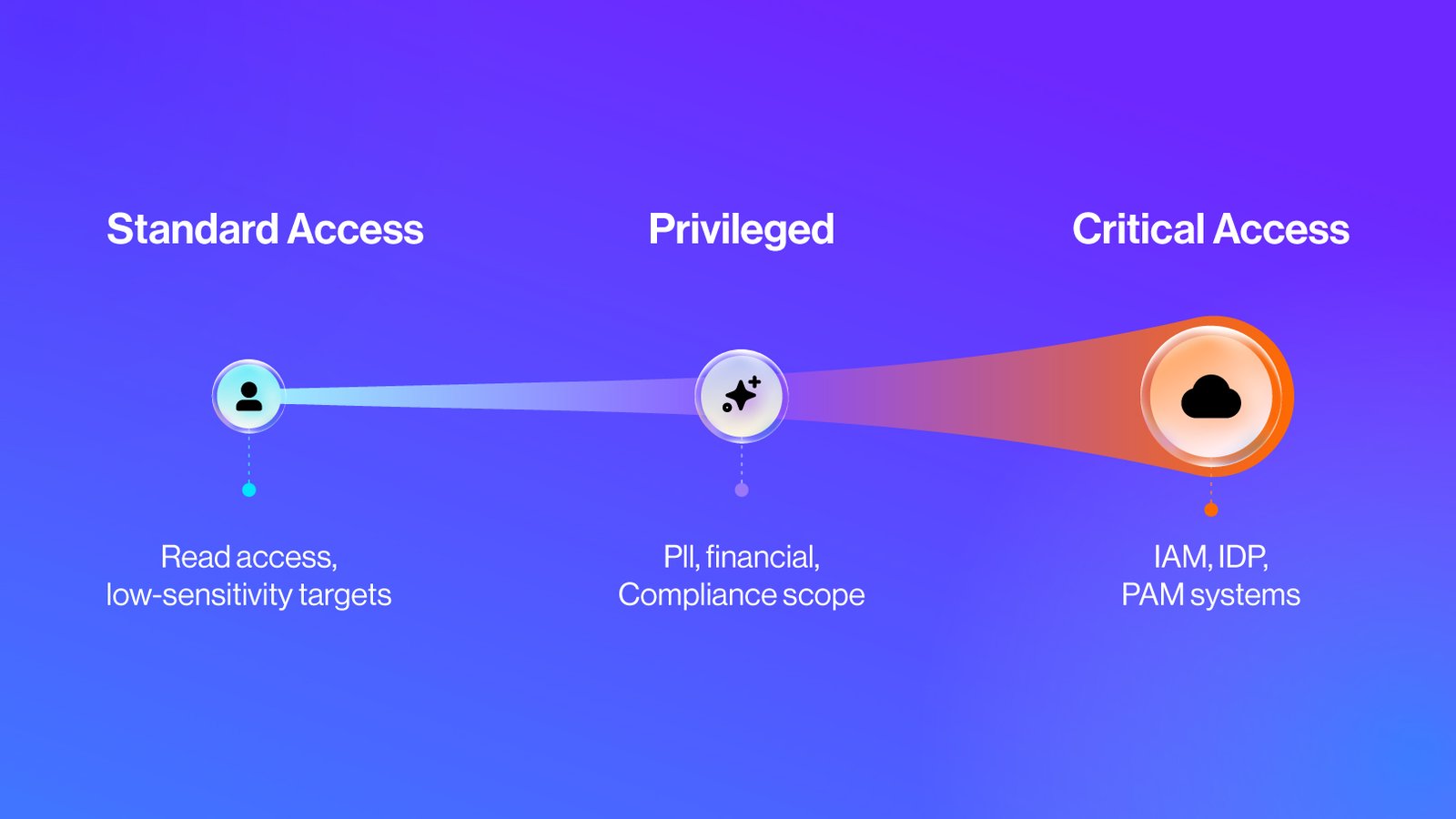
A more useful model treats privilege as a degree that can vary across identities, tasks and circumstances. Two identities in the same category may hold very different levels of authority, while an identity’s privilege may increase as its roles, access, connections or autonomy change.
A spectrum-based approach allows organizations to evaluate identities according to what they can do and the potential consequences of that access. Controls can then become stronger as authority and risk increase, without imposing the same requirements on every identity or activity.
Turning that principle into policy requires a consistent way to classify identities, to recognize when their positions change and to determine which controls belong at each level. The Privilege Spectrum webinar introduces a practical framework for making those decisions across human, nonhuman, cloud and AI identities.
Zero standing privilege must extend across the spectrum
Once privilege is understood as a spectrum, zero standing privilege becomes more than a control for administrator accounts. Any identity with consequential access may require temporary, conditional or continuously validated access.
The strength of those controls should reflect the authority and risk involved. Lower-risk activity can proceed with less friction, while access with greater potential impact warrants stronger approval, validation and enforcement. The appropriate approach depends on where the identity falls on the spectrum and what it is attempting to do.
Start asking how privileged an identity is
A modern privileged access strategy must account for how authority and risk change across identities and tasks. The next step is turning that principle into a repeatable way to classify access, recognize when privilege changes and apply controls proportionate to the potential impact. Watch The Privilege Spectrum: Securing Human, Nonhuman, Cloud, and AI Identities on demand with Theo Walker of Saviynt and Anupam Nandan of Ernst & Young LLP to learn how the framework applies across human, nonhuman, cloud and AI identities.
Watch The Privilege Spectrum on demand to explore how organizations can connect privilege spectrum classifications to a broader zero standing privilege strategy across human, nonhuman, cloud and AI identities.
FAQs
The privilege spectrum is a model for understanding privilege as variable rather than binary. It helps organizations consider the authority and potential impact associated with an identity instead of relying on a simple privileged or non-privileged label.
The binary model was designed for a smaller, more stable group of administrator and technical accounts. Modern enterprises now rely on workforce users, service accounts, cloud workloads, and AI agents that can all hold consequential access. Their level of privilege varies widely, even within the same identity type.
Identity type provides only a starting point. Organizations need a repeatable method for evaluating the authority an identity holds, the consequences of its actions, and the circumstances that may change its level of privilege. The privilege spectrum framework provides a structured approach to making that assessment.
AI agents can differ significantly in both access and autonomy. An assistant that summarizes approved documents may have narrow, read-only permissions, while a coding or financial agent may modify repositories, initiate workflows or update transactions. The shared label “AI agent” does not indicate the level of authority or risk.
Zero standing privilege reduces unnecessary permanent access across identity types. Within a spectrum-based model, organizations can strengthen access requirements as privilege and risk increase while avoiding excessive friction for lower-risk activity.
The views reflected in this article are the views of the author(s) and do not necessarily reflect the views of the global EY organization or its member firms.