Saviynt has achieved FedRAMP® Rev5 Class D (High) Certification for its unified identity security platform.
Class D is the new FedRAMP certification class corresponding to the former High impact level. As FedRAMP transitions from Impact Levels to Certification Classes, Class D is the highest current certification class under the Rev5 framework.
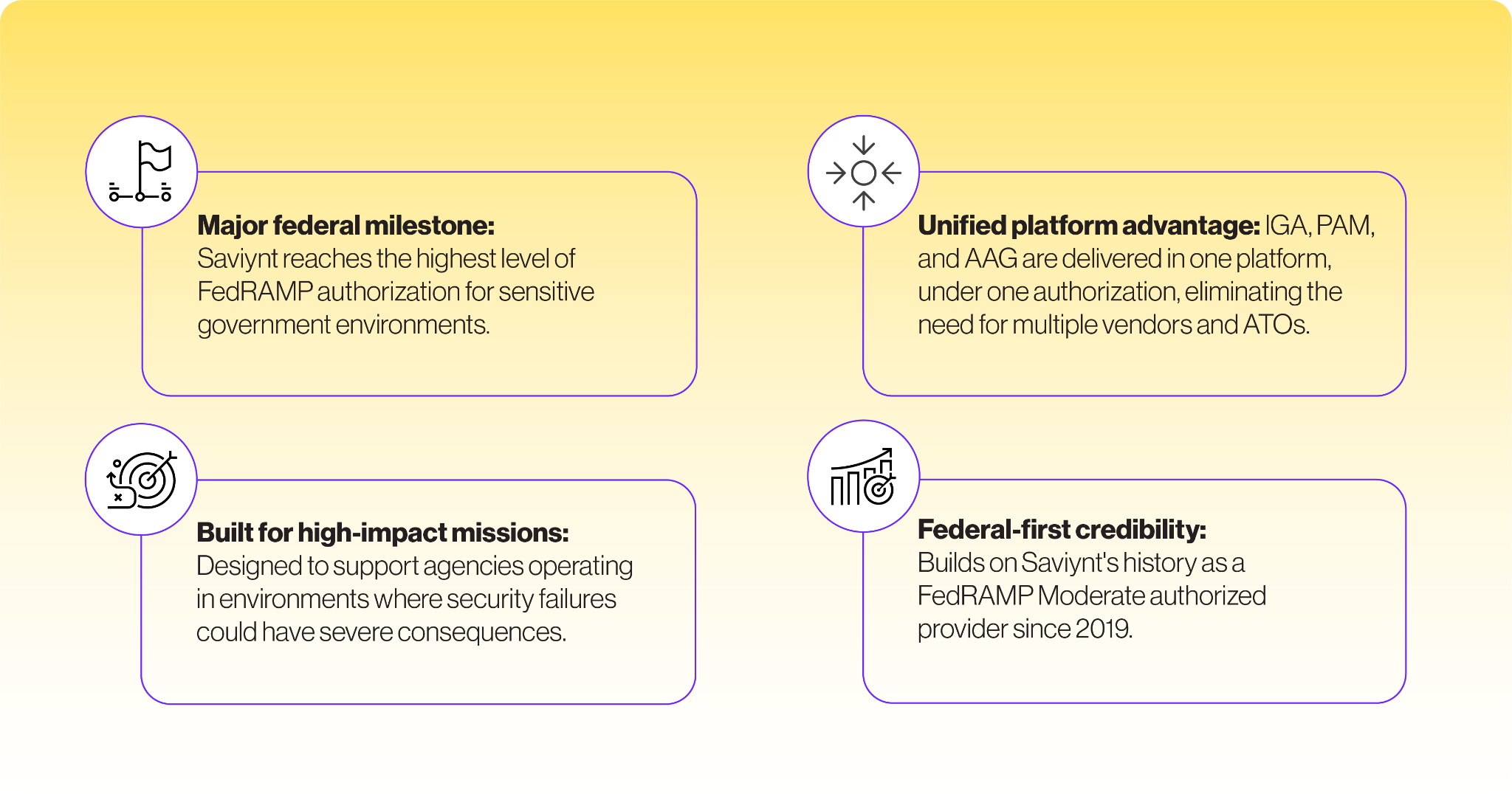
The certification covers Saviynt's unified identity security platform, including identity governance and administration (IGA), privileged access management (PAM), and application access governance (AAG). For federal agencies, that means a single certified platform can address multiple dimensions of identity risk across the enterprise.
Key findings
- Saviynt's identity security platform is pursuing FedRAMP Rev5 Class D (High) certification, the highest certification class currently available under FedRAMP's Rev5 framework.
- Class D replaces the former FedRAMP High impact level as part of FedRAMP's 2026 shift from Impact Levels to lettered Certification Classes.
- The certification scope spans identity governance (IGA), privileged access management (PAM), and application access governance (AAG) in a single platform.
- Saviynt has held FedRAMP authorization since 2019, when it became the first identity governance and cloud security platform to earn a FedRAMP Moderate ATO.
What is FedRAMP Class D — and why does it replace FedRAMP High?
FedRAMP Class D is the certification class that corresponds to the former FedRAMP High impact level under the Rev5 framework. It's the highest current certification class available under FedRAMP, and it provides assurance for cloud services supporting highly sensitive federal workloads. It does not extend to systems processing classified information.
For identity security, that level of assurance matters. Identity controls determine who can access federal systems, what they can do, and how that access is governed throughout its lifecycle.
Saviynt's federal track record: FedRAMP Moderate since 2019
Saviynt has been part of the federal cloud security ecosystem since 2019, when the company first achieved FedRAMP Moderate authorization.
Years of operating within federal security boundaries and supporting agency authorization processes informed the development of Saviynt's identity security platform. That experience now extends to Class D-certified capabilities spanning identity governance, privileged access, and application access.
The result is a platform designed to help federal organizations govern access across the systems and identities that support their missions.
One platform for the full identity security stack: IGA, PAM, and AAG together
The significance of this certification goes beyond the designation itself. Saviynt brings IGA, PAM, and AAG together within a single unified identity security platform.
Federal agencies have traditionally assembled separate technologies to address different parts of the identity problem. One system handles identity governance, another handles privileged access, and additional tools govern access within critical applications.
The result: fragmented visibility, disconnected controls, and one more system to maintain and audit.
Saviynt connects these functions on a single platform. Security teams can govern identities, control privileged access, and manage application permissions within a common identity security framework.
That allows agencies to connect questions that are often handled separately:
- Who has access?
- What can they access?
- Why do they have that access?
- What happens when that access becomes privileged?
- What risk does that access create within critical applications?
This unified approach also lets agencies address identities beyond traditional employees and contractors, including applications, service accounts, machine identities, and emerging AI-driven identities.
Why does Class D matter for federal identity security?
Class D matters for identity security because identity has become the primary control point for federal access: it determines who can reach sensitive systems, what they're authorized to do, and how that access is governed over time. As agencies extend access to applications, service accounts, machine identities, and AI agents, that control point only grows more critical.
Employees and contractors need access to sensitive systems. Administrators require privileged access to critical infrastructure. Applications and service accounts connect systems and move data. Machines increasingly act on behalf of users, while AI agents are beginning to take actions across enterprise environments.
Each creates a distinct access pathway that agencies need to understand and control.
IGA establishes who should have access; PAM limits and monitors high-risk privileged access; and AAG extends governance into the applications where sensitive business processes and data reside.
Saviynt's Class D certification assures federal agencies that their most sensitive identity data (which could create catastrophic or even life-threatening consequences if mishandled) will remain protected and mission-ready.
What federal agencies can do with a Class D-certified identity platform
With Saviynt's Class D-certified platform, federal agencies can govern identity risk across users, privileges, applications, and non-human identities from a single system, rather than stitching together point tools. Specifically, agencies can:
- Govern access across sensitive federal systems with identity governance capabilities designed for high-assurance environments.
- Manage privileged access with native PAM capabilities, including just-in-time access and session recording.
- Enforce least privilege and continuous access controls as part of a broader Zero Trust strategy.
- Govern application access across critical systems and connect application-level permissions with broader identity risk.
- Support agency authorization efforts with a FedRAMP-certified cloud foundation.
- Modernize identity governance from legacy and on-premises environments to the cloud while maintaining federal security requirements.
What does Class D mean for existing Saviynt federal customers?
The Class D certification expands the range of federal use cases that Saviynt can support. Existing customers can build on their investment in the Saviynt platform as they evaluate additional Class D and high-assurance use cases, without bringing in a new vendor for every new requirement.
Contact your Saviynt account team to discuss what the Class D certification means for your environment and roadmap.
Establish mission-critical security with Saviynt
Federal organizations can't secure a system with lagging identity controls. Access governance must match the pace of environmental change, whether the action comes from a new application, service account, or AI agent.
To learn more about how identity security can help you safeguard the mission, visit Saviynt's Federal Government Solutions page.
Frequently asked questions about FedRAMP Class D Certification
What does Saviynt's FedRAMP Class D Certification mean for federal agencies?
Saviynt's FedRAMP Rev5 Class D (High) Certification gives federal agencies a certified foundation for securing identities and access across sensitive environments. Saviynt brings Identity Governance and Administration (IGA), Privileged Access Management (PAM), and Application Access Governance (AAG) together in one platform, helping agencies reduce reliance on disconnected identity tools while strengthening access controls and oversight.
How does Saviynt's unified platform simplify federal identity security?
Saviynt consolidates core identity security functions—including IGA, PAM, and AAG—within a single platform and certified environment. Agencies can govern workforce and non-human identities, manage privileged access, and control application entitlements without maintaining separate platforms for each function. This reduces integration complexity, administrative overhead, and the number of systems security teams need to manage and audit.
How does Saviynt govern access inside mission-critical applications?
Saviynt's Application Access Governance capabilities provide fine-grained visibility into application entitlements and access risk across critical business applications. Agencies can define and enforce application-specific policies, automate access reviews, and identify separation-of-duties conflicts and other risky access combinations before they become security or compliance issues.
How does Saviynt help federal agencies implement Zero Trust?
Saviynt provides identity-centric capabilities that support federal Zero Trust requirements, including continuous access governance, least-privilege enforcement, entitlement analytics, and risk-based access decisions. The platform helps agencies move beyond static, point-in-time access reviews toward continuous verification and control across users, applications, and privileged identities.
Can Saviynt help agencies secure non-human and external identities?
Yes. Saviynt provides identity governance across employees, contractors, partners, service accounts, and non-human or machine identities within the same platform. Agencies can automate onboarding and offboarding, enforce access policies, establish appropriate ownership and review processes, and maintain visibility into identities that operate outside the traditional workforce.
How does Saviynt help agencies reduce the complexity and cost of identity security?
Saviynt consolidates identity security capabilities that agencies often purchase and manage separately. A unified platform can reduce integration requirements, duplicate administration, specialized training, and vendor management while giving security teams a common view of identity and access risk. Saviynt also automates identity lifecycle, access request, certification, and remediation processes to reduce manual work.