
AI adoption is no longer a future concern; it’s already happening. Organizations — and their users — are deploying AI through applications and developer tools, whether it’s sanctioned or not. Meanwhile, agents are accessing data, interacting with systems, and taking action with limited human oversight or intervention.
The question for CISOs is no longer how to adopt AI safely. It’s whether you can govern its use without losing visibility or control.
That challenge becomes more urgent as AI agents proliferate. Unlike traditional human identities, they operate autonomously, move across connected resources, and execute actions at machine speed and scale. Those differences require an approach to identity security designed specifically for how AI agents operate.
AI changes the conversation about information security at a fundamental level. You need visibility into where AI is operating and what it can access, along with clear ownership and governance. Most importantly, you need to continuously validate that its actions stay within the boundaries you intended. With AI in your organization, identity security needs to shift left, becoming both an organizational priority and an early step in every AI governance workflow.
AI governance must come first
For nearly every organization, the opportunity to govern AI before it enters the enterprise has already passed. Employees are using AI tools, development teams are building with them, and AI agents are acting across business systems and data. You can't rewind that adoption. What you can do is establish the governance needed to build and run AI with confidence.
That starts with AI identity security.
The organizational foundations should be familiar: clear enterprise policies, executive ownership, governance councils, approved tools, and defined processes for bringing new AI use cases into the environment. What’s changed is what those structures need to account for.
AI introduces identities that act autonomously and operate across multiple resources on behalf of users or the business. Governance must establish which AIs are permitted, who owns them, what they should be allowed to access and do, and where their boundaries lie.
The goal isn't to slow AI adoption, but to give teams a clear path to expand its use responsibly. Clear guardrails help teams put AI to work safely without creating unnecessary friction. But even the strongest policies depend on something more fundamental: visibility.
Before you can govern these identities effectively, you have to see them.
AI identity discovery: You can't govern what you can't see
Shadow AI is already in place across enterprises as employees adopt new tools, developers build AI into applications, and agents connect to data and resources outside established processes.
In fact, 92% of organizations report limited or no visibility into their AI identities. Without knowing what AI is operating, where it is connected, and who owns it, even the strongest governance policies have blind spots.
Discovery must extend beyond maintaining a list of approved AI applications. You need visibility into AI agents, copilots, and tools, including the data and resources they interact with, as well as the people or teams responsible for them. That inventory also has to keep pace as your environment changes. You can't protect what you can't see.
But discovery is the prerequisite for governance, not governance itself.
Finding a previously unknown agent tells you that it exists. It doesn't tell you whether its access is appropriate, its integrations meet security requirements, or its actions can be trusted. Once you know what's operating in your environment, the next question is more consequential: What should you trust it to do?
Every AI identity has to earn trust
Once AI identities are visible, the next step is to determine which can be trusted to act. The scale of that challenge is already significant: AI and other non-human identities now outnumber human identities by as much as 144 to 1. But volume alone isn't what makes AI different. It's what these identities can do once they're given access.
Unlike traditional identities, AI agents act autonomously and connect across applications and data sources, silently and swiftly gaining access to resources and tools far beyond what was originally provisioned. An agent granted access for one legitimate purpose may use connected tools to reach additional systems or data, expanding what it can do without returning to a human for approval.
Static permissions can't address that challenge on their own. Before trusting an AI identity to act autonomously, you need to understand the agent’s security posture. Who owns the agent? What systems and data can it reach? Which tools can it invoke, and how do those permissions work together? Most importantly, do those capabilities align with its intended purpose?
But even after you answer these questions, AI doesn’t just become trustworthy. To be secure, your AI identity security program must adopt a Zero Trust framework for your agents, LLMs, and other types of AI, provisioning on a limited-time, case-by-case basis — and with the proper guardrails in place for when something goes wrong.
After all, an AI identity that meets requirements today may gain new connections, capabilities, or access tomorrow. Maintaining security requires governance that follows every identity as it changes.
Continuous governance for AI identities
Traditional identity governance has often relied on predictable lifecycle events and periodic access reviews. AI agents don't operate on that timetable. Their access, connections, and activities change continuously, creating risk in the space between reviews. That risk is already materializing: 53% of organizations report that AI agents exceed their intended permissions.
You must govern AI identities throughout their lifecycle, from creation through termination. That means establishing clear ownership, enforcing least privilege, using Just-in-Time access where appropriate, and treating agents as first-class identities rather than peripheral technology. These aren't unfamiliar identity principles, but applying them to AI requires a more continuous approach.
However, continuous governance doesn't mean governing AI identities the same way you govern humans. Human-equivalent governance should be the floor, not the ceiling. An employee might misuse excessive access one action at a time. An autonomous agent operates at machine speed, across interconnected resources, and at a scale no human identity can match.
Your AI identity security program must reflect the difference.
However, it’s not enough to simply establish what an AI identity should be able to do. As agents act autonomously, you must know if what it’s doing is what it’s supposed to be doing. That shifts the security challenge from periodic access reviews to continuous, real-time behavior validation.
Authorization for autonomous AI agents at runtime
Real-time behavior authorization requires controls that carry through to every action an autonomous agent takes and continuously evaluate both the agent’s intent and the specific resources it’s allowed to access.
Evaluating intent is where intent-aware runtime authorization (IARA) comes in. IARA determines whether an agent's actions align with its intended purpose as they happen. An agent may have valid credentials and legitimate access, but that alone doesn't mean every action it attempts is appropriate. IARA adds that context to the authorization decision, helping keep the agent's behavior within the boundaries of the tasks it was authorized to perform.
Intent alone isn't enough, however. Fine-grained access controls address the other half of the equation by limiting what the agent can access within an authorized system. An agent tasked with summarizing RFPs, for example, may need access to a financial system and the RFPs within it. That doesn't mean it should also be able to access budgets, invoices, or other sensitive data simply because they live in the same system.
Those controls also have to operate continuously. As AI agents act autonomously, each request has to be evaluated against what the agent is trying to accomplish and what it's permitted to access and do. Together, intent-aware runtime authorization and fine-grained access controls help ensure that an agent not only has appropriate access, but uses that access within the boundaries you’ve established.
Building confidence through AI identity security
AI is already here, and waiting for the technology or the risks around it to settle isn't an option. As CISOs, our job is to create the conditions for our organizations to build and run AI confidently — without sacrificing visibility, control, and accountability.
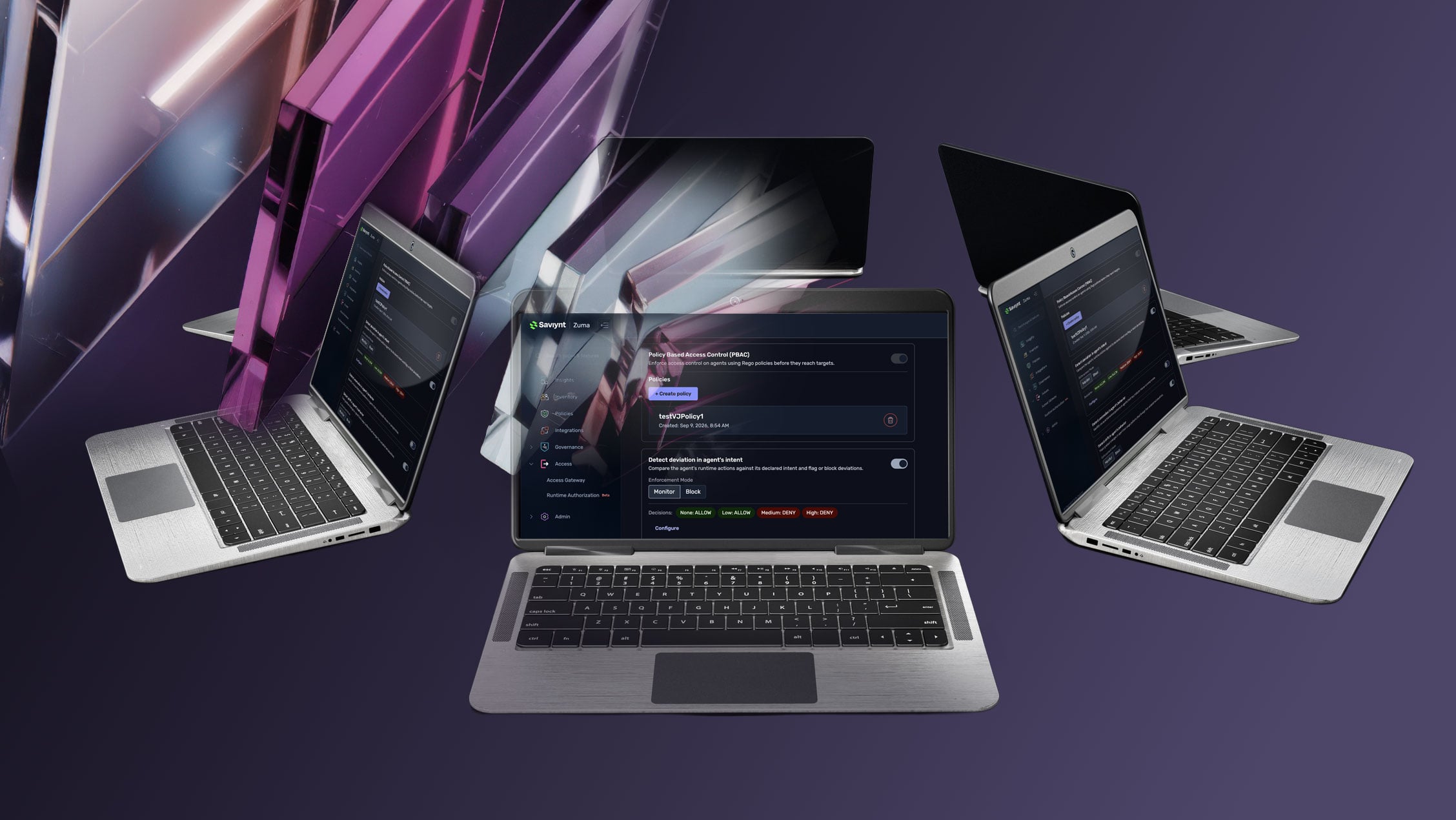
Saviynt Zuma is the enterprise AI identity security platform that is transforming how organizations approach securing their AI agents. With Zuma, CISOs can discover every AI and NHI in their organization, protect every action, and manage everything from a single control plane.
See how Zuma could help you with your AI identity security program.