- Zombie agents are unmanaged AI identities with persistent access, creating a growing identity security risk in enterprise environments

Somewhere in your enterprise, an AI agent is running right now that nobody owns.
The developer who built it moved on. The project it was scoped to has finished. But the agent is still there, authenticated, credentialed, and accessing systems continuously with no one watching. Security teams aren't seeing it because it looks like legitimate activity. IAM isn't flagging it because the tokens are valid. It has never triggered an alert, and it won't, until something goes wrong.
This is the zombie agent problem.
What makes an AI agent a “zombie”?
Zombie agents are autonomous agents that persist in your environment after their original purpose, project, or human owner is gone. They retain valid credentials, maintain access to systems, and operate with zero oversight. Unlike rogue agents (which may still be actively owned but behave beyond intent), zombie agents represent a breakdown in identity lifecycle management, operating without clear ownership or accountability for their actions, access, or associated risk.
A dormant service account is a lock with the key left in it. A zombie agent is a terminated employee who still comes to work every day, still has their badge, and answers to nobody. It scans systems and chains actions at machine speed, potentially invoking tools and APIs beyond its original scope, reaching resources its creator never intended it to touch.
Most organizations aren’t equipped to manage this. A Cloud Security Alliance survey found that only 23% of organizations have a formal, enterprise-wide strategy for AI agent identity management. Another 37% rely on informal practices. Ownership is fragmented across security teams (39%), IT departments (32%), and emerging AI functions (13%), with no clear accountability for who manages the agents after they're deployed.
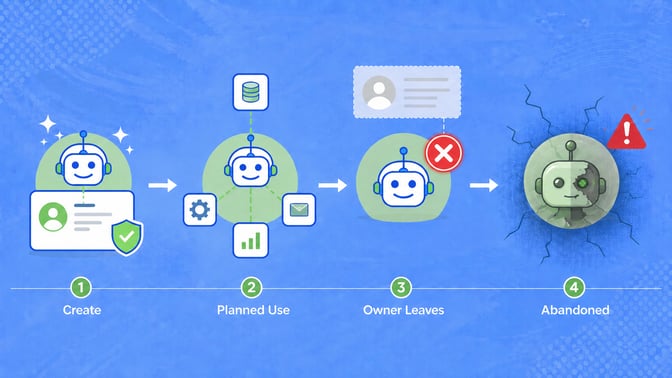
How zombie agents get created
Zombie agents are a predictable byproduct of AI adoption outpacing lifecycle controls; created for a purpose, broadly provisioned, and left running when that purpose ends. A developer builds an agent for a proof-of-concept, connects it to production data sources, and moves on to the next sprint. A contractor deploys a workflow agent during a six-month engagement, and nobody retires it when the contract ends. A business team spins up a Copilot Studio agent for a quarterly project, and the agent continues running long after the project wraps. And, in many cases, these agents are deployed outside IT's visibility entirely.
Microsoft’s Cyber Pulse report highlights the scale of this gap. While more than 80% of Fortune 500 companies deploy AI agents, only 47% have security controls in place to manage them, leaving a significant disconnect between creation and control.
Why are zombie agents such a dangerous security risk?
An over-permissioned agent with no active owner is one of the cleanest entry points an attacker can find. The agent’s existing tokens provide pre-authenticated access, letting a threat actor inherit legitimate credentials without brute-forcing anything.
This creates a blind spot for traditional identity and access management. There’s no anomalous login and no clear session boundary to monitor. The agent continues to operate as expected, executing tasks at machine speed and interacting with systems in ways that appear entirely legitimate.
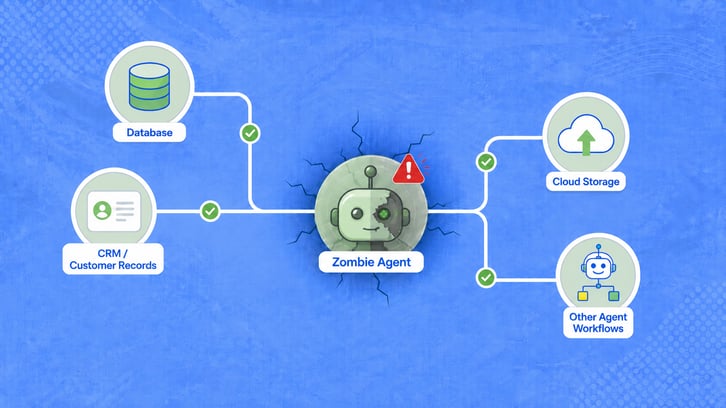
The impact escalates quickly. Once compromised, a zombie agent can move laterally across the systems it already has access to, invoking APIs, querying data stores, and chaining actions without friction. Because these actions occur within established permission boundaries, they rarely raise immediate alarms.
The blast radius compounds in multi-agent environments. As enterprises adopt protocols like Google's A2A and Anthropic's MCP, agents begin to interact with other agents, passing identity and permissions along the chain. A zombie agent sitting inside an A2A workflow corrupts the trust chain for every agent it hands off to. Each agent in that chain assumes the upstream agent is legitimate, governed, and owned by someone accountable. A zombie agent meets none of those conditions, but the downstream agents don't know that. The identity governance and administration frameworks designed for human users weren't built to track these cascading handoffs, and a single orphaned agent can compromise an entire multi-agent workflow.
How to govern zombie agents before they become a liability
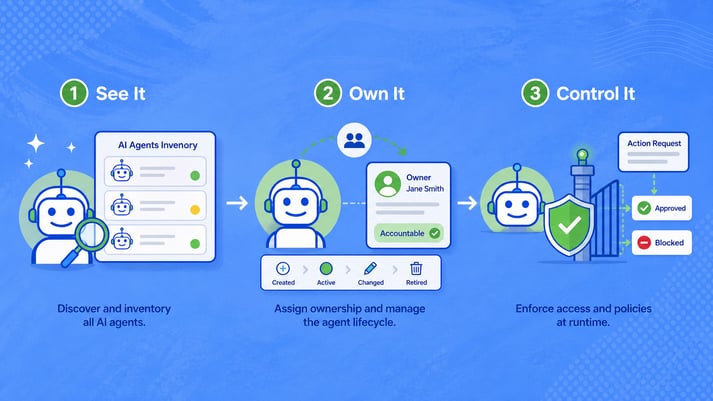
Governing AI agents follows the same principles as governing human identities: discovery, ownership, and real-time access control.
The starting point is visibility. You cannot govern agents you don’t know exist. That means discovering every agent operating across your environment, whether authorized by IT or spun up by a developer outside formal channels, across cloud and AI platforms. It also means mapping the MCP servers, underlying models, and tools that those agents rely on.
Visibility alone falls short without ownership. Every agent must have clearly defined human accountability, whether a business risk owner, technical owner, or security policy owner, from the moment it is created. When that owner changes roles or leaves the organization, ownership must be reassigned, not abandoned. Without automated lifecycle management to track and enforce these transitions, agents slip through the cracks and become invisible to the very systems meant to govern them.
The hardest piece is runtime access control. Static permissions granted at deployment are insufficient for agents that operate autonomously, chain actions dynamically, and interact with other agents. Access decisions need to happen at the moment of action, not after. Runtime access gateways evaluate each agent action against policy before allowing it to execute, flagging or blocking requests that fall outside the agent's defined scope before damage is done.
Together, these three capabilities define what governing AI agents actually require. And it is exactly what identity security posture management is built for.
Zombie agents come from governance that stops at deployment
Zombie agents signal a shift in what identity means inside the enterprise. For the first time, identities are being created that can act independently of the humans who initiated them.
The risk occurs when access management is treated as a retrofit; something layered on after agents are already running. By then, visibility is incomplete, ownership is unclear, and control is reactive. The companies that scale AI safely will be the ones that build identity into the architecture from the start.
Your next read: Managing AI Agent Lifecycles: From Registration to Retirement